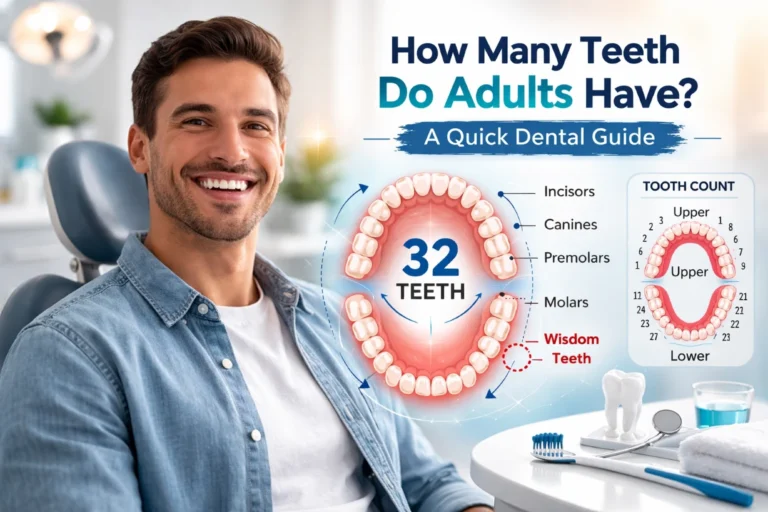
How many teeth do adults have? It sounds like a simple question, yet many of us are not fully sure of the exact number, which teeth do what, and what happens if some teeth never grow in or need to be removed. Knowing your tooth count and how your teeth work helps you take better care of your mouth for life.
How Many Teeth Do Adults Have on Average?
Most healthy adults have 32 permanent teeth. This number includes the wisdom teeth, which are the last molars at the very back of the mouth. When we ask how many teeth do adults have, dentists usually answer with this standard number: 32 adult teeth in total.
These 32 teeth are divided as follows:
- 8 incisors
- 4 canines
- 8 premolars
- 12 molars (including 4 wisdom teeth)
Many adults, however, have fewer than 32 teeth because their wisdom teeth were taken out or never formed. In that case, the common number is 28 teeth. Both 28 and 32 can be normal, but we still use the classic count of 32 when we explain how many teeth do adults have in a full, complete set.
Adult Teeth vs Baby Teeth: What Changes?
Children usually start out with 20 baby teeth, also called primary teeth. These teeth are smaller and have thinner roots. As a child grows, the roots of the baby teeth dissolve, and permanent teeth push them out and take their place.
The main differences between baby teeth and adult teeth include:
- Number: 20 baby teeth vs up to 32 adult teeth
- Size and shape: Adult teeth are larger and stronger
- Roots: Adult teeth have deeper, longer roots
- Purpose: Adult teeth are meant to last a lifetime
This change from 20 to 32 teeth is one reason people wonder how many teeth do adults have and why the number is higher than in childhood. The added teeth give extra strength for chewing and help shape the face and smile.
Names and Roles of the Different Adult Teeth
Adult teeth are not all the same. They each have a special form and job. Knowing the names and roles can make dental visits feel less confusing and help you follow your dentist’s advice with more confidence.
Incisors: The Front Cutting Teeth
Incisors are the sharp, flat teeth at the front of the mouth. Adults have 8 incisors, 4 on the top and 4 on the bottom. They are the first teeth people see when you smile.
Incisors help you:
- Bite into food like apples or sandwiches
- Cut food into smaller pieces before chewing
- Support clear speech and some letter sounds
When we explain how many teeth do adults have, the incisors are the easiest to count, since they are clearly visible in the mirror.
Canines: The Pointed Corner Teeth
Canines are the pointed teeth next to the incisors. Adults have 4 canines, two on the top and two on the bottom. They are sometimes called “eye teeth” because the upper pair sits under the eyes.
Canines are designed to:
- Tear tougher foods, such as meat or crusty bread
- Guide your bite when you move your jaw side to side
- Support the lips and overall facial shape
These teeth play a big part in your bite and smile line. When counting how many teeth do adults have that are key for chewing and guiding the jaw, canines are high on the list.
Premolars: The Transition Teeth
Premolars sit between the canines and the molars. Adults have 8 premolars, 4 on the upper jaw and 4 on the lower jaw. Children do not have premolars in their baby teeth set, which helps explain why the adult tooth count is higher.
Premolars have broad, flat surfaces with ridges that:
- Help crush and grind food into smaller pieces
- Share chewing forces to protect other teeth
- Support the height of the bite so the jaws close correctly
When we map out how many teeth do adults have and what they do, premolars act like a bridge between sharp front teeth and heavy-duty molars.
Molars: The Heavy Lifters
Molars sit at the back of the mouth and do most of the grinding work. Most adults who keep their wisdom teeth have 12 molars in total, 6 on the top and 6 on the bottom. This count includes the 4 wisdom teeth.
Molars are built to:
- Grind food into very small pieces for safe swallowing
- Handle strong chewing forces
- Keep the back of the bite stable
Because molars have deep grooves, they are more likely to get cavities if not cleaned well. When we talk about how many teeth do adults have that need extra care during brushing, molars are at the top of the list.
Wisdom Teeth: Do They Count?
Wisdom teeth, also called third molars, are the last teeth to appear. They usually start to come in between ages 17 and 25. A complete adult mouth with all wisdom teeth has 32 teeth.
However, many people:
- Have their wisdom teeth removed due to lack of space
- Have wisdom teeth that never fully come in
- Do not develop all four wisdom teeth at all
This is why a lot of adults with healthy mouths and no missing teeth still have only 28 teeth. So when we ask how many teeth do adults have in real life, the answer often becomes “between 28 and 32,” depending on the wisdom teeth.
Why Some Adults Have More or Fewer Teeth
Even though 32 is the textbook answer, real mouths are often more complex. Several factors can change how many teeth do adults have by the time they reach middle age or older.
Teeth Removed by a Dentist
Some teeth are pulled by a dentist to protect oral health. Common reasons include:
- Severe decay that cannot be repaired
- Advanced gum disease with loose teeth
- Crowding, when there is not enough space for all teeth
- Broken teeth that cannot be saved
In orthodontic cases, teeth might be removed to help the remaining teeth fit better. This changes how many teeth do adults have, but it can improve the bite and smile in the long term.
Teeth That Never Formed
Some adults are born without certain teeth. This is called congenital absence or hypodontia. For example, a person might be missing a lateral incisor or a second premolar. The empty space may close on its own, stay as a gap, or be filled with a crown or implant later on.
In such cases, how many teeth do adults have is a personal number, not just the standard 32. A dentist can confirm which teeth are present using dental X rays.
Extra Teeth: Supernumerary Teeth
Much less common, some people have too many teeth. These extra teeth are called supernumerary teeth. They can crowd the mouth, push other teeth out of place, or stay hidden in the bone.
When this happens, how many teeth do adults have can go beyond the normal 32. Dentists usually remove extra teeth to prevent problems and to keep the smile aligned.
How Adult Teeth Grow In: Timeline and Stages
The shift from baby teeth to adult teeth takes many years. It often starts around age 6 and continues into the early twenties. This long timeline shapes how many teeth do adults have at each stage of life.
General pattern:
- Ages 6 to 8: First permanent molars and lower front incisors appear
- Ages 8 to 10: Upper front incisors and side incisors replace baby teeth
- Ages 10 to 12: Premolars and canines replace baby molars and canines
- Ages 12 to 13: Second permanent molars appear at the back
- Ages 17 to 25: Wisdom teeth may come in, if they develop
By the mid-teens, most people already have 28 permanent teeth. Once wisdom teeth appear, the count may rise to 32. This step explains how many teeth do adults have at full maturity compared to teenagers.
Why Tooth Count Matters for Your Health
The number of teeth in your mouth is not just a fun fact. It connects directly to chewing, speaking, and even digestion. Losing teeth does more than change your smile; it changes how your mouth works every day.
When we look beyond the simple question of how many teeth do adults have, we see that a full set of teeth helps you:
- Chew food well, which supports better digestion
- Pronounce words more clearly
- Keep the jawbone strong and active
- Maintain facial fullness and avoid a “sunken” look
Missing many teeth can lead to shifting of the remaining teeth, bite problems, jaw pain, and even headaches. This is why dentists often suggest fillings, crowns, bridges, or implants to replace missing teeth whenever possible.
Caring for All 32 (or 28) Adult Teeth
Whether you have 32, 30, or 28 teeth, good care helps you keep them for life. The steps are simple, but doing them daily creates real long term protection.
Core habits include:
- Brushing at least twice a day with fluoride toothpaste
- Flossing once a day to clean between teeth and under the gums
- Limiting sugary snacks and drinks that feed bacteria
- Wearing a mouthguard if you play contact sports
- Seeing a dentist every 6 to 12 months for checkups and cleanings
These habits matter just as much as the number itself when we ask how many teeth do adults have that are healthy, strong, and free of pain.
How to Check Your Own Tooth Count
If you are curious to know exactly how many teeth you have now, you can do a quick, simple check at home.
Here is one easy way:
- Stand in front of a mirror with good light
- Smile wide and open your mouth
- Start on one side of the upper jaw and count each tooth to the other side
- Repeat on the bottom jaw
- Add the two numbers together
Keep in mind that some teeth, especially wisdom teeth, might be hidden under the gums or only partly visible. A dentist can give you a more accurate answer to how many teeth do adults have in your own mouth by using X rays.
When to Talk to a Dentist about Your Teeth Count
Certain changes are a sign that you should speak with a dental professional. Paying attention early can prevent bigger problems later.
Contact a dentist if you notice:
- Loose adult teeth
- Teeth that have shifted or large gaps forming
- Jaw pain or clicking while chewing
- Swelling, bleeding, or pain in the gums
- Difficulty chewing or biting foods you used to eat with ease
In these cases, how many teeth do adults have is only part of the story. The health of the gums, bone, and jaw joints matters just as much to your smile and comfort.
Conclusion: More Than Just a Number
So, how many teeth do adults have? The classic answer is 32 teeth, including 4 wisdom teeth. Many adults, however, have 28 teeth because their wisdom teeth are missing or removed. Some people have fewer teeth due to genetics or extractions, while a few have more because of extra teeth.
Knowing how many teeth do adults have, and how many you personally have, gives you a clearer picture of your oral health. It reminds us that every tooth has a job, from incisors that bite to molars that grind. With steady care, regular checkups, and quick action when something feels wrong, you can help your own set of adult teeth stay strong for decades.
Frequently Asked Questions
How many teeth do adults have without wisdom teeth?
Adults without wisdom teeth usually have 28 teeth. That includes 8 incisors, 4 canines, 8 premolars, and 8 molars. When people ask how many teeth do adults have in most modern mouths, 28 is a very common real life answer.
How many teeth do adults have on the top and bottom?
In a full set of 32 teeth, there are 16 teeth on the top jaw and 16 on the bottom jaw. If wisdom teeth are removed, adults typically have 14 teeth on the top and 14 on the bottom, adding up to 28 teeth total.
At what age do adults have all their permanent teeth?
Most people have 28 permanent teeth by age 13 or 14, after the second molars appear. Wisdom teeth, which bring the count up to 32, often come in between ages 17 and 25. So how many teeth do adults have at any given age depends on whether wisdom teeth have appeared or been removed.
Is it normal for adults to have missing teeth?
Many adults are missing at least one tooth due to decay, injury, or genetics. While it is common, it is not ideal. Missing teeth can affect chewing, speech, and jaw health. Dentists often recommend fillings, crowns, bridges, or implants to restore how many teeth do adults have that are functional in the mouth.
Can adults grow new teeth if they lose one?
Once adult teeth are lost, they do not grow back naturally. The only exception is if a permanent tooth was never formed and a baby tooth stayed in place longer. To replace a lost tooth, dentists may use implants, bridges, or partial dentures. So how many teeth do adults have is usually fixed unless restored with dental work.
Do adults need all 32 teeth to chew well?
Many adults chew well with 28 teeth and no wisdom teeth. Problems start when several other teeth are missing, especially molars. The more teeth you lose, the harder it becomes to chew certain foods. How many teeth do adults have that are healthy and well positioned matters more than simply reaching 32.
How can I keep my adult teeth for life?
Brush twice daily, floss every day, eat a balanced diet low in sugar, avoid smoking, and visit your dentist regularly. With these habits, how many teeth do adults have in your own mouth is more likely to stay close to your current healthy count for many years.