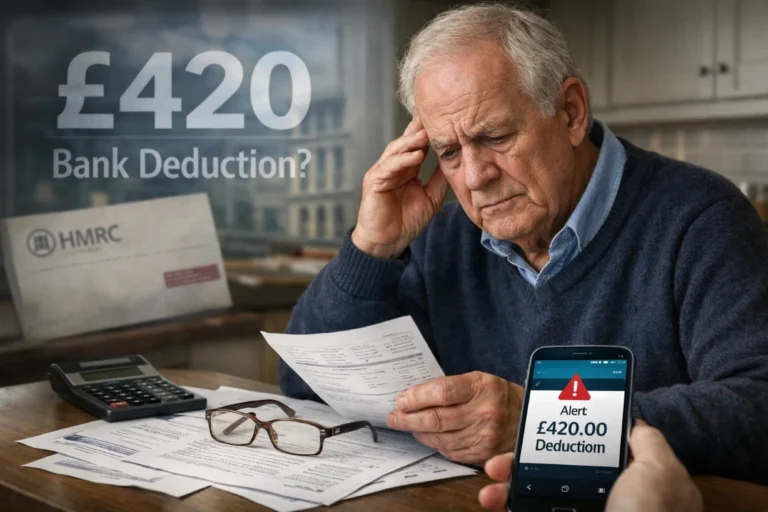
The rumours about hmrc pensioner bank deduction £420 have worried many older people and their families. Messages on social media and in group chats claim that HMRC is secretly taking 420 pounds from pensioners’ bank accounts. When we listen to callers on radio shows or read comments online, we hear the same fear again and again. People are scared that they will wake up one morning and see money taken from their savings without warning.
Where Did The HMRC Pensioner Bank Deduction £420 Rumour Come From?
This rumour did not start from an official HMRC notice. It began with a mix of real worries, half-truths, and fake stories shared online. Some people posted screenshots of bank statements with strange entries. Others shared secondhand stories like “my friend’s aunt had 420 pounds taken by the tax office.”
In our experience, many of these stories have one thing in common: almost none show clear proof that HMRC itself ordered a specific hmrc pensioner bank deduction £420. Instead, they show things like:
- Old tax debts being collected through debt agencies
- Adjustments related to benefits or overpayments
- Bank fees or direct debits taken by private companies
Once these real but confusing deductions started to spread online, people gave them a simple name: hmrc pensioner bank deduction £420. The number 420 stuck, even though the real amounts often differ.
Can HMRC Really Take Money From A Pensioner’s Bank Account?
HMRC does have legal powers to collect unpaid tax. However, those powers come with strict rules. HMRC cannot simply sneak into a pensioner’s bank account and take 420 pounds without warning, approval process, or paperwork.
There is a system called “direct recovery of debts.” It allows HMRC, in some cases, to take money from bank accounts when someone owes tax and has not paid after many reminders. But for pensioners, and for most ordinary people, this is a last resort and it is tightly controlled.
Before anything like that happens, HMRC must:
- Send clear letters about the amount owed
- Give time to challenge or question the bill
- Offer payment plans where possible
- Check that enough money will be left for basic living costs
So while HMRC does have collection powers, the picture of a sudden hmrc pensioner bank deduction £420 with no warning is not how the system is supposed to work. When something looks like that, we should suspect either a misunderstanding or a scam.
Difference Between HMRC Deductions And Bank Or DWP Changes
Part of the confusion comes from the number of different bodies that can affect a pensioner’s income or bank balance. A person might blame HMRC when the real cause is somewhere else.
Changes to pension income can come from:
- Department for Work and Pensions (DWP) adjusting State Pension or Pension Credit
- Private or workplace pension schemes correcting past payments
- Banks charging fees, interest, or reversing a previous credit
When people see a reduction of around 420 pounds, they may quickly call it a hmrc pensioner bank deduction £420, even if HMRC was not involved at all. This is why checking the exact wording of each bank transaction is so important.
Common Real Reasons A Payment Might Drop By Around £420
There are several real-life reasons why a pensioner’s income or balance might fall by a few hundred pounds in a single month. Some of the most common include:
1. Backdated tax on a private pension
If someone has a personal or workplace pension, tax can be wrongly calculated for months or even years. When HMRC corrects it, the pension provider may adjust payments, causing a one-off reduction similar to 420 pounds.
2. Overpayment of benefits
If DWP later decides that a pensioner was paid too much Pension Credit, Housing Benefit, or another benefit, it may recover the overpaid amount through future deductions. These can be quite large at first until a new plan is set up.
3. Bank taking two direct debits together
If a direct debit fails one month, the bank may take two payments the next month. That can look like a sudden hmrc pensioner bank deduction £420, especially if the direct debit is for a government-linked body or local council.
4. Debt collection agencies
Old debts like tax credit overpayments or unpaid tax can be passed to collection firms. When they take a payment, the reference might be unclear. People often assume “this must be HMRC” when in reality it is a third-party firm using a separate agreement.
How To Check If A Deduction Is Really From HMRC
When a pensioner sees money missing or a lower payment, fear can take over fast. However, there is a clear way to check whether it is really hmrc pensioner bank deduction £420 or something else.
Step 1: Look closely at the bank statement label
The name shown for the payment or deduction gives the first clue. Genuine HMRC payments have specific references like “HMRC NICO,” “HMRC PAYE,” or “HMRC Cumbernauld.” If the wording is vague or simply says “PAYMENT TAKEN,” we need more checks.
Step 2: Log into your Personal Tax Account
On the HMRC website, the Personal Tax Account shows your tax position. It lists recent payments, tax codes, and any unpaid tax. If you do not see a matching payment there, the deduction may not be from HMRC.
Step 3: Compare letters and emails
HMRC contacts people in clear, numbered letters and sometimes by secure messages in the online account. If there was no recent letter about a tax bill, a surprise hmrc pensioner bank deduction £420 is very unlikely to be genuine.
Step 4: Call using the official HMRC helpline number
Use the number from the official GOV.UK website, not from a text message or random forum. Ask HMRC whether they have taken or requested any recent payments. They can confirm what has really happened.
How Scammers Use The HMRC Pensioner Bank Deduction Story
Fraudsters watch the news and social media. When they see a rumour like hmrc pensioner bank deduction £420 spreading, they copy it and twist it for scams. We have seen several common tricks aimed at pensioners:
- Fake “HMRC refund” texts saying 420 pounds were wrongly taken and can be refunded if you click a link
- Scam calls claiming “we must take 420 pounds now or you will face court action”
- Emails pretending to be HMRC, asking for bank details to “fix an incorrect pension deduction”
These messages play on fear and confusion. They make people panic and give away information. In reality, HMRC does not ask for bank details by text, and it does not demand instant payment over the phone using gift cards, vouchers, or unusual methods.
What HMRC Normally Does With Pensioner Tax
Most pensioners who pay tax do so through a system known as Pay As You Earn, or PAYE. The tax is taken before the pension is paid. So, the usual route is a smaller pension payment, not a separate hmrc pensioner bank deduction £420 from the bank account.
HMRC uses tax codes to decide how much to take. When something changes, like starting a new private pension or receiving extra income, HMRC updates the tax code. The new code can mean higher tax, which may feel like a new deduction. But once again, this is done through the pension payer, not by quietly reaching into the bank.
Emotional Toll On Pensioners And Families
Behind every rumour of hmrc pensioner bank deduction £420, there is usually a real human story. We hear from people who sit at the kitchen table, bank statement in hand, trying to understand where their money went. Some are widows or widowers who have never handled finances before. Others are carers worried about an elderly parent losing savings.
The fear is not only about money. It is about trust. Older people often grew up in a time when official letters meant something clear and firm. When they see confusing messages now, or unclear bank entries, they feel lost and sometimes ashamed for not “keeping up.”
Families can help by sitting down together, going through each line of the statement, and making calls together. A calm voice on the phone with HMRC or the bank can ease a lot of worry.
Practical Steps If You Suspect A Wrong Deduction
If you or someone you care for thinks there has been a wrong or unfair deduction, you can take calm, simple steps:
1. Gather all paperwork
Collect bank statements, pension letters, and any emails or texts you received. Make notes of dates and amounts that look like a hmrc pensioner bank deduction £420 or any similar sum.
2. Call the bank first
Ask what company or body requested the payment. The bank can often see more detail than the short label on your online statement. They can also say if it was a card payment, direct debit, or standing order.
3. Contact the pension provider or DWP
If the change is in the pension amount, ask the provider why the payment dropped. For State Pension or benefits, call DWP using numbers from GOV.UK or letters you already have.
4. Speak to HMRC if the bank confirms a tax link
If the bank confirms that HMRC or a tax-related agency requested the money, contact HMRC and ask for an explanation. Request a breakdown of what the money covers and over what period.
5. Ask about hardship or repayment plans
If the deduction is correct but too hard to manage, ask if it can be reduced or spread out. HMRC and other bodies do sometimes agree to smaller payments, especially for vulnerable people and pensioners.
How To Protect Yourself From Future Confusion
While we cannot stop every odd rumour like hmrc pensioner bank deduction £420 from spreading online, we can make ourselves and our loved ones safer with a few habits.
First, always check the source. If a claim comes from a forwarded message, a screenshot with no name, or a friend of a friend, treat it with care. Look for confirmation on official sites like GOV.UK, not just on social media posts.
Second, keep a simple record. Writing down big changes in income, new letters, or phone calls can help later. When you see a strange deduction, you can look back and connect it with a new benefit decision, a tax letter, or a debt agreement.
Third, build a small circle of support. This can be family, close friends, or trusted advisors like a local charity, citizens advice group, or financial counselor. Having someone to call when something looks odd can bring peace of mind.
Key Facts To Remember About The Rumoured £420 Deductions
After going through all the fear, stories, and real systems behind tax and pensions, there are a few key facts we should keep in mind about any supposed hmrc pensioner bank deduction £420:
- HMRC does not usually take fixed random sums like 420 pounds without warning.
- Most real tax from pensioners is taken at source through PAYE, not later from bank accounts.
- Many cases are mistakes, benefit changes, or bank errors, not secret HMRC action.
- Scammers use the story to scare people into handing over money or personal data.
- You always have the right to ask for details, challenge bills, and request easier payment plans.
When a rumour mixes a real concern with false claims, as in the case of hmrc pensioner bank deduction £420, clarity is our best defense. Careful checking, calm questions, and trusted advice can keep both money and peace of mind safer.
Frequently Asked Questions
Is HMRC really taking £420 from all pensioners’ bank accounts?
No, there is no official HMRC rule that takes a standard 420 pounds from all pensioners. The phrase hmrc pensioner bank deduction £420 comes from online rumours and a mix of different cases, many of which are not even linked to HMRC.
What should I do if I see around £420 missing from my pension payment?
First, check if the missing amount is from the pension itself or a separate bank deduction. Then contact your pension provider or DWP to ask about changes. If they say it is tax-related, speak to HMRC to confirm whether it is truly an hmrc pensioner bank deduction £420 or another type of adjustment.
Can HMRC take money from my bank without telling me first?
HMRC is required to inform you and give chances to respond before using strong collection powers. Sudden, surprise deductions are not how the system is meant to work. If you see money taken without warning and it is claimed to be HMRC, check directly with them using official contact details.
How do I tell if a text or email about HMRC and £420 is a scam?
Be wary of messages that demand urgent action, ask you to click links to claim a refund, or request bank details. HMRC does not send refunds by text links and does not threaten arrest over the phone. If a message mentions hmrc pensioner bank deduction £420 and feels pushy, treat it as suspicious and delete it.
Could a change in my tax code cause a drop of about £420?
Yes, a new tax code can increase the tax taken from your pension, which may reduce your monthly payment by several hundred pounds. But this happens through the pension provider, not as a separate hmrc pensioner bank deduction £420 from your bank balance. Check any recent tax code letters from HMRC.
Who can help me if I do not understand a deduction on my bank statement?
You can speak to your bank, your pension provider, HMRC, or a support group such as Citizens Advice. Many charities also help older people review their money matters. Do not feel shy about asking; the systems are complex even for experts.
How can I protect an elderly relative from fake HMRC deductions?
Offer to look over statements together, help them ignore unknown texts and emails, and make sure they only use phone numbers and websites from official letters or GOV.UK. If they ever hear a story about hmrc pensioner bank deduction £420, encourage them to check with you or a trusted advisor before taking action.