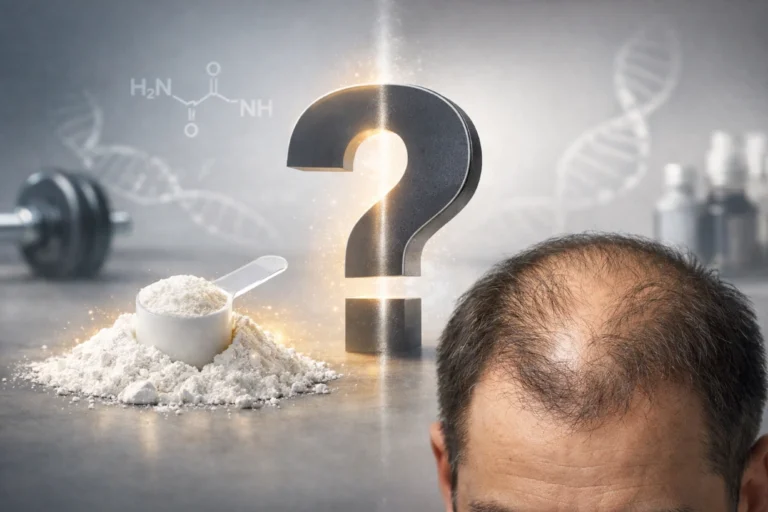
Does creatine cause hair loss? Many gym goers, athletes, and casual lifters ask this question the moment they see a few extra hairs in the shower. Creatine is one of the most researched sports supplements in the world, but fear about baldness still follows it. We wrote this guide to give a clear, honest answer that respects both the science and the real worries people feel when they see their hair change.
What Creatine Actually Is And How It Works
Before we can ask does creatine cause hair loss, we need to know what creatine really does in the body.
Creatine is a natural compound made from three amino acids: arginine, glycine, and methionine. Our liver and kidneys make it, and we also get it from foods like red meat and fish. Most of the creatine in our body sits in our muscles, where it helps make quick energy.
During short, hard efforts like sprinting or heavy lifting, our muscles use a system called the phosphocreatine system. Creatine helps recycle ATP, the main energy fuel in our cells. With more creatine stored in muscle, we can usually do a bit more work before we get tired. That is why creatine is so popular in strength training, bodybuilding, and high intensity sports.
None of this sounds related to hair, and that is where the confusion starts.
Where The Creatine Hair Loss Rumor Came From
The question does creatine cause hair loss mostly traces back to one small study from 2009 on rugby players. That study has been quoted again and again on forums and social media, often without context.
Here is what the study found in simple terms:
- Rugby players took creatine for three weeks.
- Their levels of DHT (dihydrotestosterone), a hormone linked to male pattern baldness, went up.
Because DHT is known to speed up hair loss in men who are already genetically at risk, many people jumped straight to the idea that creatine equals baldness. But the study never measured hair loss. It only measured blood levels of hormones in a small group of men over a short time.
Since then, no large, long term study has confirmed that creatine users lose more hair than non users. Still, the fear stayed, and now almost every discussion about creatine includes someone asking does creatine cause hair loss.
How Hair Loss Actually Works
To judge the claim, we need to look at what really causes most hair loss in men and women. The most common type is androgenetic alopecia, often called male pattern or female pattern baldness.
Key factors include:
- Genetics: If close relatives lost their hair early, your odds are higher.
- DHT sensitivity: Hair follicles on the scalp can be sensitive to DHT. Over time, DHT can shrink these follicles.
- Hormone balance: Testosterone, DHT, and other hormones interact with hair follicles in complex ways.
In androgenetic alopecia, hair follicles slowly miniaturize. Each new hair grows in thinner and shorter, until some follicles stop making visible hair at all. This process can start in the late teens or in the 20s or 30s, whether or not someone uses creatine.
Stress, poor diet, harsh hair treatments, thyroid issues, and some medications can also affect hair, but they do not change the base genetic plan written in our DNA.
DHT, Testosterone, And Creatine: What The Research Says
Because DHT is so strongly tied to pattern hair loss, the link between creatine and DHT is at the heart of the question: does creatine cause hair loss or just change a lab number?
So far, here is what the science shows:
1. Only one small study showed a clear rise in DHT from creatine. The 2009 rugby study is often cited. Creatine loading seemed to raise serum DHT levels compared with placebo. But the sample size was small, the time frame was short, and there was no tracking of hair density or hairline changes.
2. Many other studies on creatine did not find hair loss. Creatine has been tested for decades for strength, muscle mass, and safety. During that time, researchers did not report hair shedding as a consistent or major side effect. If creatine strongly caused baldness, we would likely see more clear data by now.
3. Blood DHT is not the only factor. Even if creatine slightly changes blood hormone levels, that does not prove it triggers follicle damage in real life. Local DHT in the scalp, receptor sensitivity, and genetics probably matter more than small shifts in blood values.
4. Creatine does not raise testosterone to steroid levels. Some people think creatine acts like anabolic steroids. It does not. Creatine does not strongly boost testosterone, and it is not a hormone. It is an energy helper in cells.
Why Many People Blame Creatine When Hair Starts To Thin
The moment someone starts lifting more seriously, they often add creatine, change their diet, and train harder. Around the same age, their natural genetic plan for hair might start to show. When they then lose hair, creatine often gets blamed first because the timing lines up.
This is a classic example of confusing correlation with causation. Two things happen around the same time, so we assume one caused the other. But other factors may be at play:
Many lifters are in their late teens or twenties, which is exactly when androgenetic alopecia often appears. Training hard may also drop body fat and change hormone balance a bit, which might unmask a pattern that was going to show up anyway. Also, people who care about their body often watch themselves more closely in the mirror, so they notice every small change, including a slightly receding hairline that was already there.
So the question does creatine cause hair loss may feel real because of the timeline in someone’s life, even if creatine itself is not the main driver.
What Current Evidence Suggests About Hair Risk
Based on research so far, can we say that creatine is safe for hair in every single person? No honest health writer can promise that. Bodies are different, and we never have perfect data. But we can look at what is most likely.
The most balanced view today is:
Creatine does not seem to be a direct hair loss drug. It does not attack hair follicles or block hair growth in known ways. For most healthy users, creatine use does not appear to cause clear, fast balding.
For people with strong genetic risk and high sensitivity to DHT, there is a small chance that anything affecting hormone balance may speed up what would happen anyway. That includes intense training, weight changes, or maybe, for a few people, creatine. But the evidence here is weak and mostly based on fear rather than large trials.
So when we ask does creatine cause hair loss, the honest answer from current science is: probably not in most people, and if there is an effect, it is likely small and limited to those already prone to male pattern hair loss.
How To Use Creatine If You Worry About Hair
Many readers want a practical path, not just theory. If you gain strength and performance from creatine but still worry about your hair, there are careful steps you can take.
Watch Your Hair Over Time
Before you start creatine, take clear photos of your hairline and crown in good light. Do the same each month for several months. Use the same angle and distance. This gives you a real record instead of a fear based impression.
If you already notice clear thinning, creatine is probably not the root cause. Look at family history and other stressors, then talk with a dermatologist or hair specialist.
Use A Standard Dose
Classic creatine use looks like this:
- Optional loading phase: about 20 grams per day split into 4 doses for 5 to 7 days.
- Maintenance phase: about 3 to 5 grams per day afterward.
You do not gain extra benefits from mega dosing creatine for long periods. Higher doses also raise the chance of stomach upset and water retention. If you are worried and still want to use it, stick to the lower end: 3 grams per day after loading, or even skip loading and just take 3 grams daily. Muscles still fill up; it just takes longer.
Choose A Simple, Pure Creatine
Creatine monohydrate is the most studied form. Use a product with third party testing and no extra stimulants or unknown mixes. If your hair changes, you want to know it is not due to another ingredient in the supplement.
Support Overall Hair Health
We cannot change our genes, but we can give our hair a better environment to grow. While you explore does creatine cause hair loss for you personally, it helps to focus on basic hair friendly habits:
- Eat enough protein, healthy fats, iron, and zinc.
- Avoid very low calorie crash diets.
- Manage heavy stress with sleep, breathing work, or therapy if needed.
- Use gentle shampoos and avoid tight hairstyles that pull on the roots.
These steps will not fully stop genetic hair loss, but they can prevent extra shedding from poor health or stress.
When To Talk With A Doctor Or Dermatologist
If you feel scared every time you wash your hair or see more scalp in the mirror, it is worth having a real medical talk rather than only asking strangers online if does creatine cause hair loss.
You should consider speaking with a professional if:
- Your hair is thinning fast over a few months.
- You have patchy loss, redness, or itching in the scalp.
- Hair is falling out in clumps.
- You feel deep anxiety or low mood tied to your appearance.
A dermatologist can check patterns, run blood tests if needed, and talk about treatments like minoxidil, finasteride, or other options. If you use creatine, share that as well. Together you can decide whether to pause it or keep it based on your personal case, not just general fear.
Balancing Muscle Goals And Hair Concerns
For many people, creatine is a simple, affordable aid for strength gains and training progress. Losing that tool out of fear can feel frustrating. At the same time, hair is tied to identity, culture, and self image. When hair starts to thin, it can feel like a small grief, even if others say it is no big deal.
So the real heart of the question does creatine cause hair loss is often emotional. People want to know whether they must trade strength for hair, or if they can have both.
Current science suggests most can have both. Creatine is one of the safest sports supplements known when used in normal doses by healthy adults. Hair loss is far more driven by genetics and age than by a single supplement. Staying informed, watching your own body, and getting help early if thinning starts will serve you better than quitting every useful aid out of fear.
Key Takeaways: Does Creatine Cause Hair Loss Or Not?
We can sum up what we know right now:
- Creatine is a natural compound that helps the body produce quick energy for intense exercise.
- The hair loss rumor comes mainly from one small study that showed higher DHT levels, not actual hair loss.
- Most large creatine studies do not report hair thinning as a common side effect.
- Genetics and DHT sensitivity are the main drivers of male and female pattern baldness.
- If creatine has any effect on hair, it is likely small and mostly in people already at high risk.
- Watching your own hair over time and talking with a dermatologist is better than trusting fear based posts.
So, does creatine cause hair loss for everyone who uses it? The evidence says no. For most lifters and athletes, creatine can be part of a smart training plan without clearly harming your hair, as long as you respect your personal risk and stay honest with yourself about changes you see.
FAQ
Does creatine cause hair loss in teenagers and young adults?
Most teenage and early adult hair loss is driven by genetics. When hair starts to thin at 18 to 25 years old, people often ask does creatine cause hair loss because they began supplements around the same time. There is no strong proof that creatine alone triggers early baldness in young users. If you see fast thinning at a young age, speak with a doctor to check for genetic or medical causes.
Will stopping creatine make my hair grow back?
If creatine is not the true cause of your hair loss, stopping it will not reverse pattern baldness. Male and female pattern hair loss usually continues unless treated. In rare cases where someone feels their hair shedding increased right after starting creatine, they may choose to stop and watch for a few months. But regrowth mainly depends on the type of hair loss, not just on creatine use.
Is creatine safe if baldness runs in my family?
Many people with strong family history of hair loss use creatine for years without clear changes in their hair. If your main concern is does creatine cause hair loss when my genetics are bad, the best step is to monitor your hair closely and speak with a dermatologist early. You might also consider proven treatments like minoxidil or finasteride if thinning appears, whether or not you keep using creatine.
Which type of creatine is least likely to cause hair loss?
There is no clear evidence that any form of creatine is better or worse for hair. Creatine monohydrate is the most studied and widely used. Fancy forms like creatine ethyl ester or buffered creatine have not shown better safety or fewer side effects. For now, the safest choice is a pure, tested creatine monohydrate taken at standard doses.
Can women lose hair from creatine?
Women also ask does creatine cause hair loss, especially if they notice widening parts or shedding. Current data in women is limited, but there is no strong research showing that creatine causes female pattern hair loss. Female hair thinning often links to hormones, age, pregnancy, menopause, thyroid issues, or iron deficiency. Any woman who notices big changes in her hair should talk with her doctor and mention all supplements she uses, including creatine.
Does creatine affect beard growth or body hair?
Some people hope creatine will help them grow a thicker beard or more body hair, while others fear it might. There is no good proof that creatine alone makes facial or body hair grow more. Hair in those areas is mostly controlled by genetics and androgens. The same goes for scalp hair: creatine is not a hair growth or hair loss drug in any reliable way.
How long should I test creatine if I am worried about hair loss?
If you want to see for yourself whether creatine affects your hair, consider trying it for 3 to 6 months while taking monthly photos. If you do not see clear change, the odds that creatine is a big factor are low. If you do notice worrying thinning, stop creatine for several months and talk with a dermatologist to separate timing from true cause. This careful approach respects both your training goals and your concern about whether does creatine cause hair loss for you personally.