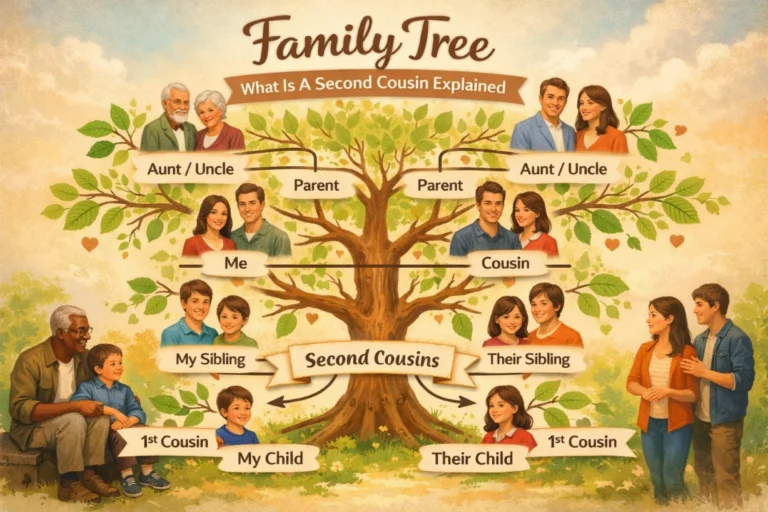
Family history can feel confusing when we come across terms like first cousin, second cousin, or cousin once removed. Many of us quietly ask ourselves what is a second cousin and how that person is different from other family members. When we map out a family tree, these small details start to make sense and help us see our relatives in a much clearer way.
Why Second Cousins Matter In Your Family Tree
When we learn what is a second cousin, we are not just learning a word. We are learning how our family connects across generations. Second cousins often appear at weddings, reunions, or funerals. They may feel familiar, but we might not know exactly how we are related to them.
Knowing these ties helps us:
- Understand how many branches our family tree really has
- Talk more clearly about relatives when sharing stories or doing genealogy research
- Build stronger connections with extended family members
This small piece of knowledge can also help when we use DNA testing websites, work on ancestry charts, or explain relatives to children who are just starting to notice how big their family is.
What Is A Second Cousin In Simple Terms
The shortest answer to what is a second cousin is this: second cousins share the same great grandparents, but they do not share the same grandparents or parents.
We can break this down step by step:
Imagine your great grandparents at the top of the family tree. They have two children. Those two children are siblings. Each of those siblings has a child. Those children are first cousins to each other. Then each of those first cousins grows up and has a child. Those children are second cousins to each other.
So your second cousin is the child of your parent’s cousin, as long as the cousin is your parent’s first cousin, and you two are in the same generation.
The Difference Between First Cousins And Second Cousins
Many people mix up first and second cousins, so we should set them side by side. When we ask what is a second cousin, it helps to see how different it is from a first cousin.
First Cousins
First cousins share the same grandparents. Your aunt’s or uncle’s children are your first cousins. You have one generation between you and the shared ancestors, your grandparents.
Second Cousins
Second cousins share the same great grandparents. You and your second cousin both have two generations between you and the shared ancestors. Your grandparents are siblings, not the same person.
So the main test is this. Count how many generations you go back to reach the shared ancestor:
- If you share grandparents, you are first cousins.
- If you share great grandparents, you are second cousins.
This simple counting method helps you answer what is a second cousin without needing charts every time.
How To Picture Second Cousins On A Family Tree
Family trees look like ladders. Each level, or rung, is a generation. People on the same horizontal line are in the same generation. To see what is a second cousin on a tree, we look for two people in the same row who share great grandparents.
Here is one way to picture it in your mind:
Top row: Great grandparents. Next row: Their children. Next row: Grandchildren. Next row: Great grandchildren.
Second cousins live in that great grandchildren row. Their parents are first cousins in the row above them. Both of those rows connect back to the same great grandparents at the top.
If you ever feel unsure, start from yourself, move up the tree to find the shared ancestor, then move down to your relative. Count the steps up to the shared ancestor. That number tells you the cousin level.
What Does “Once Removed” Have To Do With Second Cousins
After we solve what is a second cousin, another question appears. What does “once removed” mean, and how does it relate to second cousins?
The words “once removed” or “twice removed” do not change who you share as an ancestor. They only tell you that the two people are from different generations.
Here is how it works with second cousins:
- Second cousin: same generation, share great grandparents.
- Second cousin once removed: one generation apart, but still share great grandparents.
- Second cousin twice removed: two generations apart, still share great grandparents.
So your father’s second cousin is your second cousin once removed. You are one generation below your father, but your father and that cousin share great grandparents. You still connect to the same great grandparents, but at a different level on the tree.
Common Mistakes People Make About Second Cousins
When people wonder what is a second cousin, they often mix up cousins with removed cousins or distant aunts and uncles. Here are three common mistakes:
1. Calling Any Distant Cousin A Second Cousin
Some families call any cousin they do not see often a “second cousin.” But the term has a clear meaning. If you do not share great grandparents, that person is not truly your second cousin in family history terms.
2. Mixing Up Second Cousins And Cousins Once Removed
Many think their parent’s cousin is a second cousin. That relative is actually a first cousin to your parent and a first cousin once removed to you. The “removed” part shows the generation gap.
3. Thinking A Second Cousin Is Not Real Family
Some people see second cousins as “too distant” to count. Yet they share real blood ties through your great grandparents. In some cultures, second cousins are close friends, neighbors, or even like siblings.
Why Knowing What Is A Second Cousin Helps In Genealogy Research
Family history work and DNA websites often use terms like second cousin, third cousin, and more. If we do not clearly know what is a second cousin, the results can feel confusing or even wrong.
When a DNA site tells you someone is likely a second cousin, it means your DNA match suggests you share great grandparents or a similar level of shared ancestry. That clue can help you narrow down which branch of the tree they belong to.
Better knowledge of cousin terms helps you:
- Organize DNA matches into clear groups
- Build better family tree diagrams
- Spot errors when someone is placed in the wrong branch
For example, if a match is listed as a possible second cousin and you already know what is a second cousin, you know to look at your great grandparent level, not just at your grandparents or parents.
How Culture Changes The Way We Talk About Second Cousins
Even when we agree on what is a second cousin in strict genealogy, different cultures use cousin words in different ways. In some families, every relative of a similar age is called “cousin” without number or detail. In others, second cousins are called by special names or even treated like distant siblings.
Some cultures also follow strong rules about who can marry whom. In those places, it can matter very much to know whether someone is a first cousin, second cousin, or further away. In daily life in America, though, second cousins often feel like friendly but slightly distant relatives.
So, while the family tree meaning of what is a second cousin stays the same, the way we talk about and value those cousins can change from home to home and country to country.
Explaining Second Cousins To Kids
Parents often struggle to explain what is a second cousin to children. The idea of great grandparents and shared ancestors may feel big for a young mind. But easy pictures and short words can help.
One simple way is to use a story. You can say: “Grandma and Uncle Joe’s grandma were sisters. Their kids became cousins. When those cousins had kids, those kids became second cousins. So you and Sam are second cousins because you share the same great grandparents, but you do not have the same grandparents.”
You can also draw a simple tree with stick figures. Put the great grandparents at the top, then circle all the children who are second cousins on the same row. When kids see it, they often understand faster than when they just hear words.
Health, Genetics, And Second Cousins
Sometimes people worry about health when they ask what is a second cousin. They may wonder how much DNA second cousins share and if that matters for medical or marriage reasons.
On average, second cousins share only a small part of their DNA. Most studies say it is around 3 percent. This is much less than siblings or first cousins share. Because of that, second cousins are usually seen as distant relatives in genetic terms.
Doctors and genetic counselors may still ask about second cousins if they are looking into rare genetic diseases that run in certain family lines. In those cases, knowing what is a second cousin and being able to name those relatives can help give a full picture of family health history.
Practical Ways To Track Second Cousins In Your Tree
As your family grows, it can feel hard to keep track of who is who. When you know what is a second cousin, you can use a simple system to track them clearly.
Here are a few practical tips:
- Start with your great grandparents and list all their children.
- Under each child, list their children (your grandparents and their siblings).
- Under each of those, list their children (your parents’ generation).
- Under that, list your generation.
Now circle everyone in your generation who has the same great grandparents but different grandparents. Those are all your second cousins. Label them in your notes so you do not forget.
With this system, you see clearly what is a second cousin without guessing or relying on memory alone.
Second Cousins At Family Gatherings
At many family reunions, people see each other once every few years. Names blur, and it may feel awkward to ask again how everyone is related. When you already know what is a second cousin, you can walk into those spaces with more confidence.
You may decide to make simple name tags with space for “branch” or “great grandparent line.” That way, you can see at a glance which great grandparents you share with someone. Over time, you learn who your second cousins are by face, not just by word.
Some families enjoy telling children, “These are your second cousins,” to show that the bond is real and valued. This phrase gives young people a sense that their family is wide and that their roots go back through several generations.
Conclusion: Why The Term Second Cousin Still Matters
When someone asks what is a second cousin, they may think they want a short, simple reply. Yet hidden inside that answer is a long chain of people, stories, and shared history. A second cousin is not just a label. It is proof that your great grandparents’ lives still echo in new generations.
By learning the real meaning of what is a second cousin, we learn to read our family tree with clearer eyes. We see who shares our great grandparents, how distant relatives connect, and why our extended family is richer and larger than we might first think. This knowledge helps in genealogy work, DNA research, health history, and in the quiet joy of knowing where we come from.
Frequently Asked Questions About Second Cousins
Are second cousins considered close relatives?
Second cousins share great grandparents, so they are blood relatives, but more distant than first cousins. In many families, they are seen as extended family rather than close daily relatives. Still, knowing what is a second cousin helps you see that the bond is real and based on shared ancestors.
Can second cousins marry?
In most parts of the United States, marriage between second cousins is legal. They share far less DNA than first cousins. Laws may differ by country, though, so local rules should always be checked. Many people ask what is a second cousin in this context because they want to know how close the relation truly is.
How much DNA do second cousins usually share?
On average, second cousins share around 3 percent of their DNA, though this can vary. This level fits with the family tree idea of what is a second cousin, since you both trace back to the same great grandparents but are not closely related like siblings or first cousins.
Is my mom’s cousin my second cousin?
No. Your mom’s first cousin is your first cousin once removed. You and that person do not share great grandparents at the same generation level, so they do not match the family tree rule for what is a second cousin. Their child, however, may be your second cousin if you are in the same generation.
How do I know if someone is my second cousin or my cousin once removed?
First, find the shared ancestor. Then count generations from each of you to that person. If you both are the same number of generations away and share great grandparents, that person is your second cousin. If one of you is closer by one generation, then they are a cousin once removed. This method is the clearest way to decide what is a second cousin in your case.
What is the difference between a second cousin and a third cousin?
Second cousins share great grandparents. Third cousins share great great grandparents. Each step up in cousin number adds one more “great” to the shared ancestor level. When we ask what is a second cousin, we are talking about people two generations below shared great grandparents, not further back like third cousins.
Why does my DNA test say someone is a “second to fourth cousin”?
DNA tests estimate how much DNA you share. Sometimes the amount fits more than one possible relationship. When a site lists “second to fourth cousin,” it means the shared DNA could match what is a second cousin, third cousin, or even fourth cousin. Building a family tree and checking who shares your great grandparents or great great grandparents can narrow it down.