
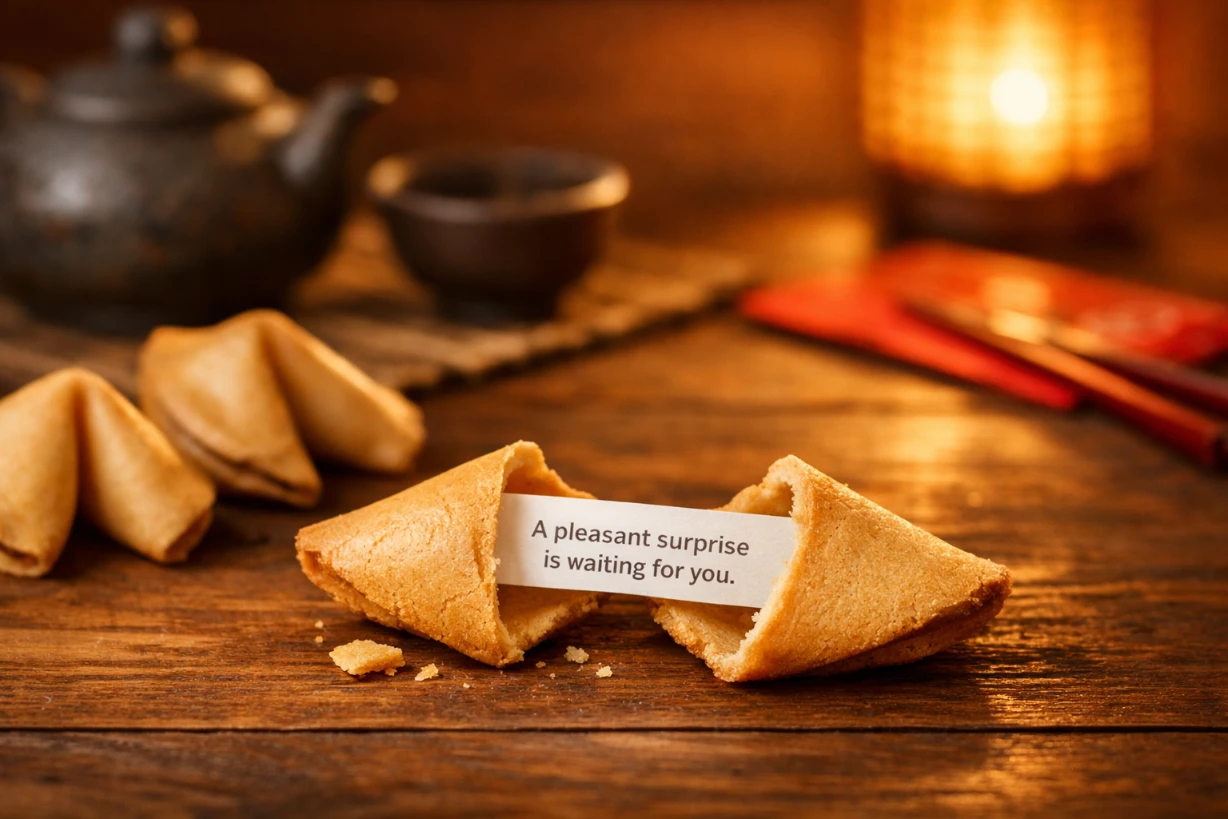
Fortune cookie is more than a small crunchy dessert at the end of a meal. For many of us, it is a moment of quiet hope, a tiny surprise wrapped in a folded cookie that makes us pause and smile. We crack it open, smooth out the little paper, and wonder for a split second if the words inside might really say something about our life.
The fascinating story of the fortune cookie
Most people think fortune cookie comes from old China. The truth is more surprising and, in many ways, more American than we expect. The modern fortune cookie grew up in the United States, shaped by immigration, war, and changes in food culture.
Early roots in Japan and China
Before the fortune cookie appeared in American Chinese restaurants, there were similar sweets in Japan. In the Kyoto area, people made a larger cookie called “tsujiura senbei.” It was a brown, slightly salty cracker folded around a paper slip with a fortune or short saying. Sellers often made them at temples and shrines, especially for people praying for good luck.
In China, written fortunes were not baked into cookies, but the idea of messages about fate and luck has a deep history. Ancient Chinese texts include oracle bones, divination sticks, and poetic lines used to tell the future. So even if the exact fortune cookie shape did not come from China, the love of short wise sayings and predictions certainly did.
Arrival in the United States
Japanese immigrants brought the idea of a cookie with a paper message to the U.S. in the late 1800s and early 1900s. In cities like San Francisco and Los Angeles, Japanese-run tea gardens and bakeries served an early form of fortune cookie to visitors. These cookies were often hand folded and flavored with sesame or miso.
Over time, Chinese American business owners noticed how much guests enjoyed this sweet surprise. After World War II, Chinese restaurants began serving fortune cookie with American-style Chinese dishes. The cookie slowly became strongly linked with Chinese food in the minds of customers, even though Japanese bakers had helped start the tradition.
Who really invented the fortune cookie
Several people claimed to be the “true” inventor of the fortune cookie. For example, Makoto Hagiwara, who worked at the Japanese Tea Garden in San Francisco, reportedly served a form of fortune cookie there in the early 1900s. In Los Angeles, David Jung, a Chinese immigrant and founder of the Hong Kong Noodle Company, also claimed he created fortune cookie around 1918 to cheer up poor people on the streets with biblical messages inside.
There was even a playful court “trial” held in 1983 in San Francisco to decide where the first fortune cookie came from. A panel listened to different stories then sided with the Japanese Tea Garden version. While this ruling was symbolic and not a legal decision, it shows how deeply people care about the true background of this tiny treat.
How fortune cookie became part of Chinese American culture
When we finish a meal at a Chinese restaurant in the United States, we almost expect a fortune cookie to arrive with the bill. This habit did not grow by accident. It formed as Chinese American owners got creative with how to please guests who were new to Chinese flavors and customs.
Many early Chinese immigrants faced harsh discrimination and strict laws that limited where they could work. Running restaurants and laundries became some of the few ways they could make a living. To survive and succeed, they adapted recipes and service styles to what American diners wanted. Serving fortune cookie at the end of a meal became a friendly way to end the dining experience with something fun, light, and memorable.
By the mid-1900s, American-made fortune cookie was being sold in massive amounts. Industrial baking machines could fold thousands of cookies per hour. Paper fortunes were printed in bulk and dropped inside each cookie as the dough was still warm and flexible. What started as a hand-made temple snack in Japan and a hopeful idea in immigrant kitchens became a mass-produced symbol of “Chinese food” in the West.
The meaning inside a fortune cookie
At first glance, a fortune cookie seems simple. There is a folded cookie, a short message, and sometimes a lucky number. Yet the meaning people find in this tiny dessert can be surprisingly deep.
Types of messages you can find
Most fortunes fall into one of several common styles:
- Predictions of luck or success such as “Good news will come your way soon.”
- Life advice or moral lessons like “Patience is the key to joy.”
- Compliments and positive traits such as “You are admired more than you realize.”
- Motivational lines like “Your hard work will lead to new doors.”
- Jokes or playful messages that make people laugh instead of predict anything.
Many modern fortune cookie companies also add phrases about love, travel, or career choices. Some add lottery numbers, which many people use in real lottery games, hoping that a random cookie will bring real money.
Why we care about these tiny fortunes
When we read the paper inside a fortune cookie, we often read it through the lens of our own life. A simple sentence can feel important when we are facing change, making plans, or feeling unsure. Human beings are naturally good at finding meaning in small signs. We look for patterns and links, even when we know the message is random.
In that way, fortune cookie acts almost like a modern version of an oracle, but in a friendly, light-hearted form. We know it is a game, but part of us still wonders, “What if this is true?” This mix of doubt and hope is what makes opening a fortune cookie feel both silly and special, no matter our age.
Do fortune cookie predict the future
From a rational point of view, fortune cookie cannot truly see the future. The messages are printed long before they reach any person, and they are handed out at random. Yet people often remember the ones that seem to fit their situation and quickly forget the ones that do not. This selective memory makes the whole experience feel more magical than it really is.
Even if the fortune is not magic, it can still help us in another way. A short sentence about courage or kindness can push us to act. When a fortune cookie says, “An exciting opportunity is near,” we might pay closer attention to chances we would normally ignore. So while the cookie does not shape our future, it can change how we see our choices.
How fortune cookies are made today
Modern fortune cookie production mixes old traditions with new technology. If we visit a large factory, we see lines of machines that heat, bake, fold, and cool thousands of cookies every hour.
The basic ingredients
Most recipes for fortune cookie use simple pantry items. Typical ingredients include:
- Flour for structure
- Sugar for sweetness
- Egg whites for crisp texture
- Vegetable oil for smoothness
- Vanilla or other flavors
The batter is poured onto a hot griddle in small round pools. As it heats, each circle firms up but stays flexible for a brief moment. That short window is when the paper fortune is placed in the middle, and the cookie is folded by machine into its familiar shape. Once it cools, the fortune cookie becomes crisp and holds its form.
Mass production and regional twists
Companies in the United States produce millions of fortune cookie every day. Some factories ship mostly to Chinese restaurants, while others package them for grocery stores and online gift orders. There are also smaller bakeries that make custom fortune cookie with special messages for weddings, birthdays, and business promotions.
In some areas, flavors go beyond the plain vanilla style. You may find chocolate-dipped fortune cookie, strawberry-flavored cookies, or even colorful versions for holidays. The basic idea remains the same, but the look and taste can change based on local tastes and creative bakers.
Fun facts about fortune cookie you may not know
Because fortune cookie is so common in American life, we sometimes overlook how strange and interesting it truly is. Here are a few facts that show just how far this snack has traveled.
First, the fortune cookie is far more popular in the United States than in China. In many parts of mainland China, people see it as an American idea. Tourists who expect fortune cookie in Chinese restaurants there are often surprised when they do not appear.
Second, during the mid-2000s, there was a famous lottery event linked to fortune cookie numbers. In 2005, thousands of people across the United States won smaller lottery prizes using the same set of “lucky numbers” found in their cookies. The odds of so many matching wins shocked lottery officials and led to news stories about the fortune cookie that “beat the odds,” even though it was still random chance.
Third, there is a National Fortune Cookie Day in the United States, often marked on September 13 or sometimes July 20, depending on which source we follow. On this day, some restaurants and bakeries offer free fortune cookie or release special, limited-time fortunes.
Fourth, custom fortune cookie has grown into its own mini-industry. Couples order them for wedding favors with personal love messages. Brands use them in marketing campaigns, printing small slogans or discount codes inside. Some people even propose marriage with a fortune cookie that holds the words “Will you marry me?” tucked between the folds.
Cultural meaning of fortune cookie today
Fortune cookie stands at a unique place between cultures. It is shaped by Chinese and Japanese roots, produced mainly in America, and known in many countries through movies and TV shows. When we see a fortune cookie on screen, we instantly think of Chinese takeout boxes, city nights, and shared meals with family or friends.
At the same time, the cookie shows how immigrant groups have built new traditions in a new land. It reflects a history of hardship, adaptation, and creativity. Even though the fortune cookie is not truly an ancient Chinese tradition, it honors the long love of written wisdom in East Asian cultures, while also speaking to the American habit of turning food into fun experiences.
For some people, fortune cookie is also a way to start conversations about culture. Children might ask, “Is this really Chinese?” which opens the door to discuss migration, mixed traditions, and how new customs begin. In that sense, this small cookie becomes an easy way to talk about big ideas.
How to enjoy fortune cookie in new ways
We usually eat fortune cookie at restaurants, but there are many other ways to add them to our lives and even our kitchens.
At home and at parties
Fortune cookie can turn a simple meal at home into something playful. We can buy a bag of them from the store and bring them out at the end of dinner. Family members can read their fortunes out loud, guess whose fortune fits best, or write their own messages and trade them for fun.
At birthday parties or New Year events, a bowl of fortune cookie on the table invites guests to share their readings and laugh together. They work well as party favors, especially if we use custom messages linked to the event or the guest of honor.
Creative projects with fortune cookie
Some people use fortune cookie as a starting point for art or journaling. We can write a story based on the message inside, or set a weekly challenge that matches the words we receive. A simple fortune like “Try something new this week” can become a small promise to ourselves.
Teachers sometimes use fortune cookie in classrooms. They may ask students to rewrite their fortunes as poems, translate them into another language, or debate whether the advice inside is wise or not. These small slips of paper can open big discussions.
Why fortune cookie still matter
Even in a time filled with apps, texts, and constant digital messages, the old fashioned fortune cookie still has a place. It is physical. We have to touch it, break it, read it, and decide what it means to us. That small ritual slows us down for a moment and gives us something to think about, or at least something to laugh about.
For restaurants, fortune cookie is a low-cost way to send guests home with a final smile. For families and friends, it is a simple way to share a moment of surprise. For children, it is often their first experience with the idea that words on paper can feel magical.
Most of all, fortune cookie is a reminder that cultures are not frozen. They grow, blend, and change as people move and meet each other. A dessert invented or shaped in one place can become a symbol of another. When we open a fortune cookie, we are not just eating a light snack. We are touching a long story about travel, hope, and human creativity.
Frequently asked questions about fortune cookie
Are fortune cookies really Chinese?
Fortune cookie is strongly linked with Chinese restaurants in the United States, but most historians agree it was developed in its modern form in America, with roots in Japanese temple cookies and Chinese traditions of written wisdom. In mainland China, people often view it as a foreign or American idea.
Do people in China eat fortune cookies?
In most Chinese cities, standard Chinese restaurants do not serve fortune cookie. You might find them in tourist-heavy areas, Western-style chains, or gift shops, but they are not a normal part of everyday Chinese meals the way they are in American Chinese dining.
Can fortune cookie tell the future?
Fortune cookie cannot truly predict the future. The messages are written and printed before they are placed into cookies, and the cookies are given out at random. Any match between a fortune and real life is coincidence, though many people enjoy imagining a deeper connection.
What do the lucky numbers in fortune cookies mean?
The numbers printed under the message in a fortune cookie are often called “lucky numbers.” They are usually chosen at random or by simple number patterns. Some people use them for lottery tickets or as playful charms, but there is no proven link between those numbers and real luck.
Can I write my own fortune cookie messages?
Yes. Many online shops and local bakeries let you order custom fortune cookie with your own words inside. You can also make homemade cookies and slide in small paper strips you print or write yourself. This is popular for weddings, classroom events, and family gatherings.
Are fortune cookies vegan or gluten free?
Traditional fortune cookie usually contain wheat flour and sometimes eggs, so they are not gluten free and may not be vegan. However, some specialty brands offer vegan or gluten free fortune cookie. Checking the package label or asking the maker is the best way to know for sure.
Why do some fortune cookies have jokes instead of fortunes?
Companies often mix styles to keep the experience fun. Along with classic future-themed messages, they may add jokes, riddles, or silly lines. This keeps people guessing and gives them something to share and laugh about at the table, which helps keep fortune cookie popular.
How long do fortune cookies stay fresh?
Stored in a cool, dry place, unopened fortune cookie usually stays crisp for several months. Once opened, it is best to eat the cookie soon, because moisture in the air can make it soft. Even if it goes a bit stale, the message inside a fortune cookie will still be there, waiting to be read.