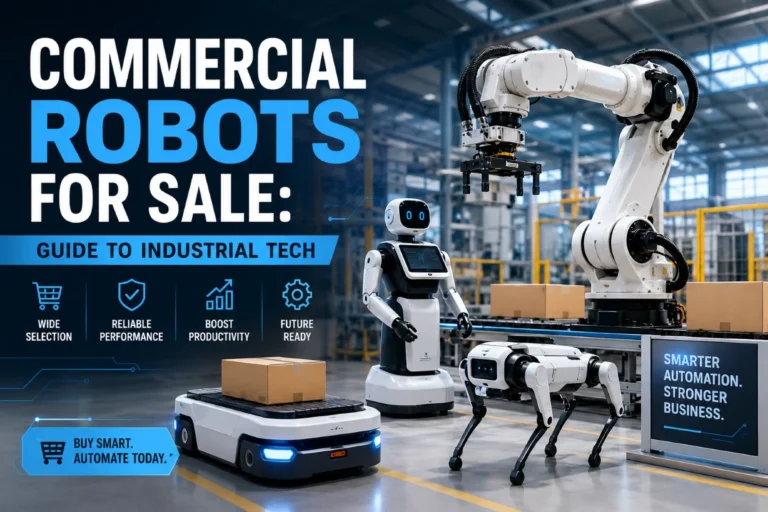
Commercial robots for sale are no longer science fiction. We see them in factories, warehouses, hospitals, farms, and even small workshops. When we walk into a modern plant and watch a robot arm weld with perfect accuracy or see a mobile robot roll by with a pallet, we realize how much industrial tech has changed.
What We Mean By Commercial Robots For Sale
When we talk about robots for sale in a commercial sense, we mean machines built and sold for real work in business, not for home toys or hobby kits. These systems are designed to work all day, follow safety rules, and pay for themselves through higher output and lower labor cost.
Most industrial robots for sale share three traits:
First, they move with repeatable accuracy. Second, they connect to software that controls tasks and tracks data. Third, they are built to handle tough settings such as heat, dust, and heavy loads.
Still, not all robots are the same. A robot arm that picks small parts on an assembly line is very different from a self-driving tugger in a warehouse. To choose the right robots for sale for your company, we need to know the main types.
Main Types Of Commercial Robots For Sale
Industrial Robot Arms
Industrial arms are what many people picture when they think of robots for sale. These are multi-joint arms that move like a human arm, just with more strength and speed. They can weld, paint, pick parts, screw parts together, or pack boxes.
Key features:
- High speed and repeat accuracy for the same motion, thousands of times per day
- Payload ratings from a few ounces to over a ton
- Reach from short, compact arms to long-reach units for large parts
These robots work best in stable, repeatable jobs where the workpiece always sits in almost the same place. Car makers, metal shops, and electronics plants use them heavily.
Collaborative Robots (Cobots)
Cobots are robots for sale made to work near people with little or no guarding. They move slower, use rounded shapes, and include sensors that stop motion if they bump into a person.
We see cobots in:
Small and medium factories that cannot afford huge cages or long downtime. Job shops where tasks change often. Labs that need gentle, precise handling of glass, samples, or tools.
Cobots are easier to program than classic industrial robots. Many let workers guide the arm by hand and “teach” points. This lowers the barrier for teams that do not have deep robot skills yet.
Automated Guided Vehicles (AGVs) And AMRs
Material handling is a huge part of modern industry, and robots for sale in this space come in two main forms.
AGVs follow fixed paths, often with magnetic tape or QR codes on the floor. They are steady and simple but not very flexible. AMRs, or autonomous mobile robots, use cameras and lasers to build maps and move on their own paths. They can go around people, carts, or boxes in real time.
Common uses:
- Moving pallets and bins between storage and lines
- Replenishing parts along assembly cells
- Shuttle carts in hospitals and hotels
These mobile robots for sale take over walking and pushing tasks, which are tiring and can cause strain injuries over time.
Service And Cleaning Robots
Commercial service robots for sale include hospital delivery carts, hotel room service robots, and large floor cleaning units used in airports or retail stores. They may not work with heavy parts, but they free staff to focus on guests and patients instead of long, repetitive trips or mopping wide floor space.
Special-Purpose Industrial Robots
Some robots for sale are built for very narrow jobs: pipe inspection, tank cleaning, mining, nuclear work, or high-heat casting. These systems may use tracks, cables, or special arms. Their value comes from doing work that is dangerous or impossible for people.
Key Use Cases Driving Demand For Robots For Sale
Assembly And Production Lines
On assembly lines, robots handle precise, repeat tasks such as screwing, clipping, pressing, and gluing. A well-tuned robot can place a tiny screw in the exact place thousands of times without fatigue.
We often see mixed lines where cobots work next to human operators. The robot does the dull or heavy motion while the worker handles inspection, tricky alignment, or custom work.
Packaging, Palletizing, And Logistics
End-of-line packaging is one of the fastest growing fields for robots for sale. Case packers and palletizing robots build neat stacks that fit trucks and containers, while also cutting injury risk from lifting.
In big warehouses, AMRs and robotic arms combine to build mixed pallets for store orders. Vision systems let them see various box sizes and labels. This was once a hard problem, but new cameras and AI tools make it more reliable each year.
Welding, Painting, And Coating
Welding robots keep a steady arc and uniform bead, which is hard for humans to match hour after hour. Painting and coating robots keep workers away from fumes and overspray.
These robots for sale often tie into process control systems. They can log every weld or spray pass, which helps with quality audits and certification.
Inspection And Quality Control
Machine vision robots inspect parts faster than human eyes. They can spot tiny cracks, color shade changes, or missing pieces in milliseconds. In electronics, vision-guided robots for sale check solder joints on boards and sort out bad units before they reach final test.
Healthcare And Lab Automation
Hospitals and labs now buy robots for sale to move samples, prepare test tubes, and deliver drugs or linens. These robots reduce human contact with biohazards and help labs handle large testing volumes without delay.
How To Choose The Right Commercial Robots For Sale
Start From The Problem, Not The Robot
Many teams fall in love with a brand or a cool demo video. A better path is to start with a painful workflow. Where do we see overtime, high scrap, safety incidents, or constant rework? These are good candidates for automation.
We then ask:
- Can the task be broken into clear steps?
- Are the input parts consistent enough in size and position?
- How often does the product change?
- What cycle time do we need per part or order?
With these answers we can match the right robots for sale to the real job.
Technical Factors To Evaluate
When we compare different industrial robots for sale, we look at a set of practical numbers and features.
Payload and reach: The robot must lift the part and tooling with margin, and its reach must cover all work points. Stretching a robot beyond its sweet spot hurts speed and life.
Repeatability: This tells us how closely the robot can return to the same point. Tight assembly and machining often need very high repeatability.
Speed and cycle time: Faster is not always better. We balance needed output with safety and wear. Still, cycle time must match the line pace, or the robot will turn into a bottleneck.
Programming and integration: We review how easy it is to program, whether it supports standard fieldbuses, and how well it fits with existing PLCs, MES, and WMS systems.
Safety: Sensing, emergency stops, safety-rated slow modes, and certifications all matter, especially for cobots and mobile robots for sale that share space with people.
Cost, ROI, And Total Cost Of Ownership
Price tags of robots for sale can range from under ten thousand dollars to several hundred thousand per system. The raw robot arm or AMR is only part of the cost. We also count:
- Grippers, tooling, and fixtures
- Safety fencing or sensors
- Engineering, programming, and testing
- Training for operators and maintenance staff
- Ongoing service contracts and spare parts
Return on investment often comes from several sources at once: fewer defects, less rework, lower scrap, shorter lead time, and more stable delivery to customers. When we look at robots for sale just as a headcount swap, we miss part of the real benefit.
Steps To Bring Robots Into Your Operation
1. Map Your Current Process
Walk the floor, take notes, and build a simple map of how work flows. Time each step, watch for waits and rework, and talk with the people who run the process every day. They often know exactly where a robot could help or where one would only get in the way.
2. Pick One Pilot Project
Instead of trying to automate the whole plant, choose a single, contained project for the first robots for sale you buy. A good pilot is high impact but low risk, with clear success metrics such as cycle time, scrap rate, or accident reduction.
3. Work With Experienced Integrators
Most companies do not have deep robot skills in house yet. A capable system integrator understands both the technology and plant life. They help specify hardware, design tooling, write programs, and handle safety studies.
We like to see a close partnership here. Your engineers and operators learn while the integrator sets up the first cells. Over time, more work can shift in-house.
4. Train Your Team
Training is not an extra step. It is part of the project. Operators learn how to start, stop, and teach simple changes. Maintenance staff learn how to handle basic faults and preventive checks.
Clear, calm training also helps ease fears about robots for sale and job security. Workers see that robots are tools that remove the worst tasks, while humans still handle problem solving and oversight.
5. Plan For Maintenance And Upgrades
Robots are durable, but only if we keep them clean, within load limits, and up to date on software. Set a schedule for grease changes, calibration checks, and safety inspections. Ask vendors about long-term parts support and how long they keep each model active.
Common Myths About Robots For Sale
“Robots Take All The Jobs”
The fear that robots for sale will replace all workers is strong, and it comes from real anxiety. What we see in practice is more nuanced. Robots tend to replace tasks, not people as whole human beings.
They take on the work that is dirty, dull, or dangerous. This frees humans to move into roles that need judgment, creativity, and direct contact with customers. New jobs appear in robot care, process design, and data analysis.
“Only Big Corporations Can Afford Robots”
Price points are shifting. Cobots and compact arms now cost far less than older, heavy industrial units. Leasing and robots-as-a-service models spread cost over time. Even a small metal shop or bakery can now look at entry-level robots for sale for simple, repeat tasks.
“Robots Are Too Hard To Program”
Past generations did need deep code skills. Many new systems use drag and drop interfaces, block-based logic, and hand-guided teaching. This does not remove the need for careful design, but it opens the door for more teams.
The Future Of Industrial Robots For Sale
AI And Vision-Driven Flexibility
As cameras, depth sensors, and AI models improve, robots can handle more varied tasks and messier input. Picking random parts from bins, sorting used items, or handling mixed pallets all get easier. This makes robots for sale attractive in less structured settings like recycling and agriculture.
Closer Human-Robot Collaboration
We expect more mixed cells where humans and robots stand close together, each doing what they do best. This needs strong safety design, clear signals, and trust built through reliable behavior.
Standardization And Easier Integration
Open standards for robot communication and control keep growing. Over time, this should make it easier to plug new robots for sale into existing lines without major rewrites of code or wiring.
Ethical And Human Sides Of Buying Robots For Sale
Industrial tech decisions are not just about throughput. They affect people, families, and local communities. When a company buys robots for sale, it helps to speak plainly with the workforce about why and how.
We can:
- Include operators in design talks so robots fit real work styles
- Offer reskilling paths into maintenance and programming roles
- Share data on safety gains and quality improvements
When workers see robots reduce back pain, cuts, or night shift pressure, acceptance grows. The goal is not cold efficiency at any cost, but safer, more stable work where people and machines support each other.
Conclusion: Finding The Right Robots For Sale For Your Business
Commercial robots for sale are now part of normal business decisions, like buying a new CNC machine or a new delivery truck. They come in many forms, from fast industrial arms to gentle cobots and smart mobile platforms that glide through warehouses.
Choosing well means starting with real problems on your floor, matching them to the right type of robot, and planning for people, training, and long-term care. When we do this with care and honesty, robots for sale become tools that raise quality, cut risk, and give teams more room to focus on the work that truly needs human minds and hands.
FAQs
What industries use commercial robots for sale the most?
Automotive, electronics, metalworking, food and beverage, logistics, and pharmaceuticals are among the biggest users. Hospitals and farms are quickly adding more robots for sale as systems become easier to clean, safer, and more flexible.
How much do industrial robots for sale usually cost?
Simple cobots can start under twenty thousand dollars, while large, high-payload arms may cost over one hundred thousand. Full systems, including tooling and integration, can range higher. Many vendors now offer leasing or pay-per-use models to spread the cost over time.
How long does it take to install a new robot cell?
Small, stand-alone cells might be installed and tuned in a few weeks. Complex, multi-robot systems tied into several lines can take months from design to full production. Good planning and clear scope help keep timelines under control.
Do I need engineers on staff to run robots for sale?
You need at least a few people trained in basic operation and fault handling. For complex changes or new products, you may call in your integrator or vendor. Over time, many plants grow their own internal automation team to gain more control and speed.
Can robots for sale work safely around people?
Yes, if they are designed and set up with safety in mind. Cobots and some mobile robots include built-in safety features. Risk assessments, proper zoning, speed limits, and clear rules help people and machines share space without harm.
How do I know if a process is a good fit for a robot?
Good candidates are repetitive, high volume, and have clear steps. Tasks that cause strain or injury risk, or that require very steady precision, are also strong options. A brief study with an integrator can confirm if robots for sale make sense for your case.
Will robots for sale replace all manual work in my facility?
Most sites end up with a mix. Robots handle stable, repeat tasks, while humans manage changeovers, custom work, complex decisions, and oversight. The best results come from blending both, not trying to remove every manual task at once.