
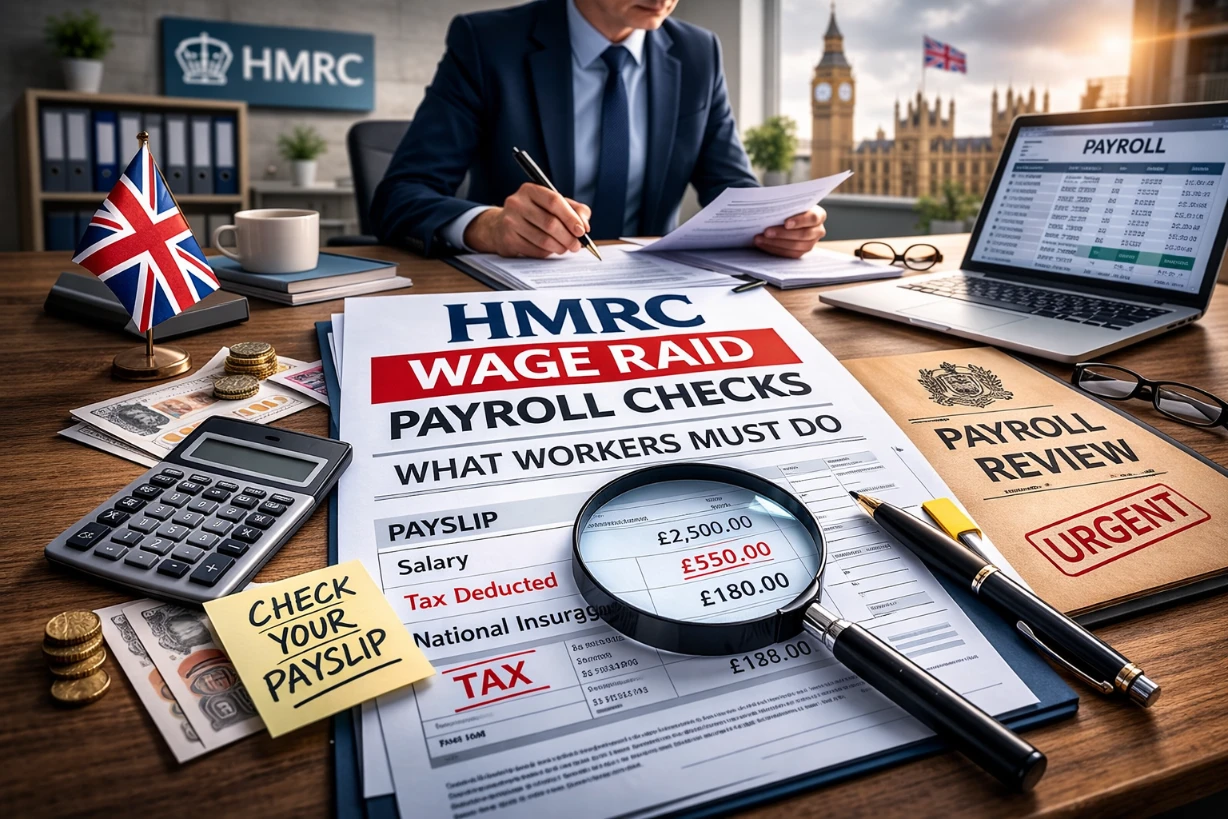
HMRC wage raid payroll checks can feel scary if you are a worker who suddenly sees tax officers at your workplace. Worries about unpaid tax, missing payslips, or mistakes on your payslip can rise fast. We wrote this guide to help workers know what is going on, what HMRC is looking for, and what steps you should take to protect yourself and your pay.
What HMRC Wage Raid Payroll Checks Actually Are
HMRC wage raid payroll checks are surprise visits from HM Revenue & Customs to business sites. HMRC officers arrive without warning and review payroll records, wage slips, contracts, and time sheets. They do this to see if the employer is following UK tax law and paying the correct tax and National Insurance for staff.
These visits are not only about the company. They can affect workers directly. If your employer has made payroll mistakes, HMRC may look at your personal records too, such as your tax code, hours worked, and pay history.
During hmrc wage raid payroll checks, officers may talk to workers on the spot. They may ask questions like how many hours you work, how you get paid, or if you receive holiday pay. Your honest answers can help HMRC spot problems such as unpaid minimum wage or hidden cash payments.
Why HMRC Does Wage Raid Payroll Checks
HMRC uses wage raid payroll checks to tackle non compliance in payroll. Some employers try to cut costs by not paying correct tax, not reporting all workers, or ignoring minimum wage rules. Others simply make serious mistakes because they do not understand the rules.
The main goals of these checks are:
- To find unpaid tax, National Insurance, and student loan repayments
- To confirm that workers receive at least the National Minimum Wage or National Living Wage
- To check if holiday pay, sick pay, and pension duties are followed correctly
- To uncover cash-in-hand work that is not reported
- To make sure PAYE and Real Time Information (RTI) rules are being followed
From your point of view as a worker, hmrc wage raid payroll checks can lead to good outcomes, such as back pay for underpayments, correction of your tax code, and better records for your future pension.
How A Surprise HMRC Payroll Visit Usually Works
When HMRC officers arrive, they will speak to the business owner or manager. They will explain that they are carrying out payroll checks and will ask to see records. In some cases, they may show a formal notice allowing them to inspect documents.
Here is what can happen during hmrc wage raid payroll checks:
First, officers review payroll records. They may ask for payslips, contracts, time sheets, payroll software outputs, and bank statements. They compare what the employer says with what has been submitted to HMRC through PAYE.
Second, they may speak to staff. They can ask workers simple questions about pay, hours, and job roles. They may want to know if you get payslips, if you are on a zero hours contract, or how overtime is paid.
Third, if they see something wrong, they can widen the review. They may request more years of records or focus on certain groups, such as part time workers, agency workers, or migrant staff.
Finally, after the visit, HMRC can issue demands for unpaid tax, penalties for the employer, and sometimes refunds or back pay for workers.
What Workers Should Do If HMRC Arrives
If hmrc wage raid payroll checks happen at your workplace, you may feel pressured or anxious. Try to stay calm and remember that you have rights. Here are clear steps you can take.
Stay Polite, Stay Honest
You are allowed to speak to HMRC officers, and they are allowed to ask you questions. You should answer truthfully. Lying can cause more problems later, both for you and others.
If you do not know an answer, say so. It is better to admit you are not sure than to guess. For example, if you do not remember your exact hourly rate, you can say that you need to check your payslip.
Ask For Identification
Real HMRC officers will carry ID. You can ask to see it before sharing any personal details. This protects you from scams. If something feels wrong, you can ask to speak to a manager or call HMRC’s public number to confirm the visit is real.
Do Not Destroy Or Hide Information
During hmrc wage raid payroll checks, it is a crime for anyone to destroy records on purpose to block the inspection. While this duty falls mostly on the employer, workers should not delete messages, remove papers, or change documents at someone’s request.
If a manager tells you to hide things or lie to HMRC, that is a red flag. You may wish to make a private note of what was said in case you need it later.
Your Rights As A Worker During Payroll Checks
Even when hmrc wage raid payroll checks take place, you still have rights. You are not powerless. The law gives you some protection.
You have the right to be treated with respect. HMRC officers should not threaten, shout at, or insult you. They can ask firm questions, but they must stay professional.
You have the right to ask for questions to be repeated or explained in simple language. If English is not your first language, you can say you do not understand and ask for clearer words or an interpreter.
You also have the right to check your own records. You can ask your employer for your payslips, P60, P45, and written contract. Even outside hmrc wage raid payroll checks, you have a legal right to a payslip every time you are paid.
Signs That Your Employer’s Payroll Might Be Wrong
Sometimes, a worker already feels that something is wrong even before HMRC shows up. If any of these signs sound familiar, hmrc wage raid payroll checks may confirm your worries.
- You do not receive a payslip, or the payslip has very little detail
- Your hours on the payslip are lower than the hours you actually worked
- You are paid in cash with no record or with random notes on paper
- Your tax code looks strange or changes often without clear reason
- You are asked to work “off the books” for some shifts
- You are not paid for holiday, or your holiday pay seems far too low
If any of these apply, you should start keeping your own records. Note your hours, keep copies of messages about shifts, and save bank statements showing your pay. These records can help you later if hmrc wage raid payroll checks lead to questions about your pay.
How To Prepare Yourself Before Any HMRC Payroll Check
You cannot control when HMRC visits your employer, but you can control how prepared you are. Having your own evidence puts you in a stronger position.
Keep your payslips. Store them in a folder or scan them. They show your pay, tax, and National Insurance for each pay period. When hmrc wage raid payroll checks happen, comparing these to HMRC records can reveal errors.
Record your hours. Use a notebook or a simple phone app to write down the hours you work each day. Include breaks, overtime, and night shifts. Do this even if your employer has a clock in system. Your version can help if there is a dispute.
Know your basic rights. Learn the minimum wage for your age group and the rules on holiday pay. This way, if HMRC or your employer asks, you can speak with more confidence.
What Happens To You After HMRC Finds Payroll Problems
Workers often fear that hmrc wage raid payroll checks will lead to punishment for them. In most cases, HMRC aims its action at the employer, not the worker, especially if you are on PAYE and not running your own business.
If your employer has not reported your pay correctly, HMRC may adjust your tax position. This can include:
- Fixing your tax code so future pay deductions are correct
- Sending you a tax calculation showing underpaid or overpaid tax
- Arranging refunds if you paid too much tax in earlier years
If HMRC sees that you knew about a tax dodge and took part in it, such as hiding income from self employment, then you may face your own tax investigation. But for normal employees with payslips, hmrc wage raid payroll checks mostly aim to correct the employer’s behavior.
Getting Back Pay And Missing Wages
One positive outcome of hmrc wage raid payroll checks can be back pay. When HMRC sees that workers were paid below the legal minimum or had unlawful deductions, they can order the employer to pay the shortfall.
Back pay may cover several years, depending on the type of breach. You might receive extra pay for:
Unpaid hours, such as mandatory meetings, training time, or putting on safety gear. Underpaid holiday pay, especially for people paid by the hour or doing regular overtime. Incorrect rounding of time, where small slices of time are cut off every shift.
HMRC may also publicly name employers who break minimum wage rules. This can push companies to fix problems quickly to avoid damage to their reputation.
What To Do If You Think Your Employer Is Cheating Payroll Rules
Sometimes workers see clear wrongdoing long before any hmrc wage raid payroll checks appear. If you suspect serious payroll abuse, you have several options.
You can first raise it quietly inside the business. Speak to HR, payroll, or a trusted manager. Keep a record of when you raised your concern and what reply you got.
If nothing changes, you can talk to a union if you are a member. Unions handle wage issues every day and know how to deal with tricky employers.
You can also report issues directly to HMRC through their confidential hotlines or online forms. You can do this without giving your name, though giving details helps HMRC look into it more deeply.
Protecting Your Mental Health During Payroll Investigations
HMRC wage raid payroll checks can stir up worry, anger, and fear. People may feel ashamed that their pay was wrong or scared about their job. These feelings are normal.
Try not to face this alone. Talk to coworkers you trust. They may share your concerns and can support you. Speak to family or friends about your stress. Sometimes just saying the words out loud helps.
If the strain becomes too heavy, consider speaking to a professional adviser, such as Citizens Advice, or a mental health helpline. Job and money problems hit self respect hard, and reaching for help shows strength, not weakness.
Key Takeaways For Workers Facing HMRC Wage Raid Payroll Checks
When hmrc wage raid payroll checks happen, they can change how a workplace runs. For some, they reveal deep problems that have been hidden for years. For others, they simply confirm that payroll is being handled correctly.
As a worker, your best protection is knowledge and records. Keep your payslips, track your hours, and learn your basic rights to fair pay and tax. If HMRC visits, stay calm, answer honestly, and remember that these checks often fix problems rather than create them.
In the end, hmrc wage raid payroll checks aim to make sure workers are paid fairly, taxes are correct, and the system is honest. By knowing what to do and how to respond, you can move through the process with confidence and protect both your pay and your peace of mind.
Frequently Asked Questions
Can HMRC talk to me directly during wage raid payroll checks?
Yes. HMRC officers can speak to workers during hmrc wage raid payroll checks. They may ask about your hours, pay rate, and how you are paid. You should answer truthfully, and you can ask them to repeat or explain questions if you do not understand.
Will I get in trouble if my employer has done payroll fraud?
Most employees will not be punished if they did not knowingly help with fraud. HMRC wage raid payroll checks usually target the employer. You might see changes to your tax code or receive a tax refund, but that is part of fixing errors, not punishing you.
Can I refuse to answer HMRC questions at work?
You cannot be forced to talk, but refusing to answer during hmrc wage raid payroll checks might raise suspicion. If you feel nervous, you can say you are uncomfortable and would like to give written answers later, or you can ask for advice from a union or legal adviser.
What should I do if my payslips do not match my actual hours?
Start by writing down your real hours and keeping all payslips. Raise the issue with payroll or HR in writing. If nothing changes, you can seek help from Citizens Advice, a union, or, in serious cases, report your concern to HMRC, who may later carry out wage raid payroll checks.
Can HMRC wage raid payroll checks lead to me getting back pay?
Yes. If HMRC finds that you were underpaid, for example below the minimum wage or with unlawful deductions, they can order your employer to pay you the missing amounts. Many workers only receive what they are owed after hmrc wage raid payroll checks reveal the shortfall.
How do I know if my tax code is wrong?
Check your tax code on your payslip or P60 and compare it with the code explanation on HMRC’s website. If your code seems odd or has changed without reason, contact HMRC. Problems uncovered in hmrc wage raid payroll checks can also lead to HMRC fixing your tax code for the future.
What records should I keep in case of payroll investigations?
Keep all payslips, P60s, P45s, your contract or offer letter, and any emails or messages about pay and hours. Also keep your own log of hours worked. These records are very useful if HMRC wage raid payroll checks highlight gaps or errors in your employer’s records.