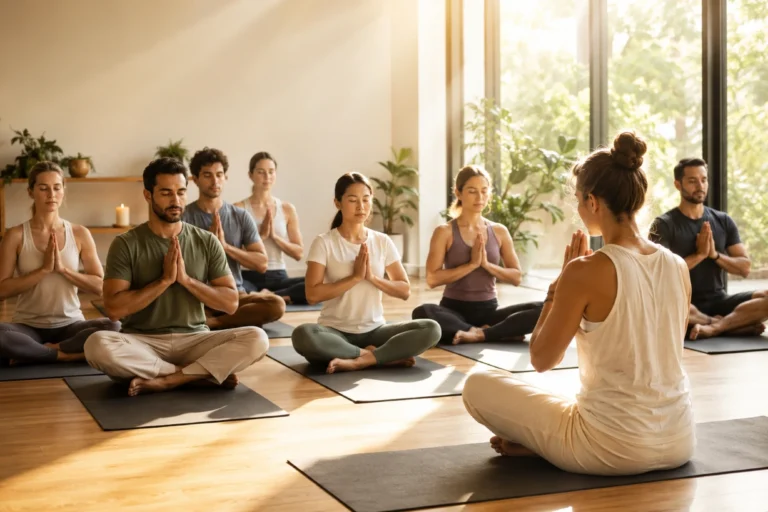
Many students notice the same ritual again and again: class slows down, we rest for a moment in stillness, sit up, bring our hands together, bow our heads, and say a single word. Namaste. We may wonder quietly, why do yoga classes end with namaste every time, in studios all across the world?
This simple word carries history, culture, and emotion. When we say it at the end of class, we are not just repeating a habit. We are taking part in a tradition that started long before yoga mats, music playlists, and studio memberships existed.
What Does “Namaste” Actually Mean?
To answer why do yoga classes end with namaste every time, we first need to look at the word itself. Namaste comes from Sanskrit, an ancient language from India. It is a respectful greeting still used in India and Nepal in daily life.
The word can be broken into two parts:
- Nama which means to bow or show respect
- Te which means to you
So namaste can be read as “I bow to you.” Many teachers expand this idea in a spiritual way, saying things like “The light in me honors the light in you.” Different teachers use different words, but they all point to the same feeling of mutual respect and shared humanity.
Why Do Yoga Classes End With Namaste Every Time?
We often ask why do yoga classes end with namaste every time instead of another phrase. The answer lies in what yoga is meant to be.
Yoga is not only exercise. It is a practice that brings together body, breath, mind, and in many traditions, spirit. Throughout class, we move, breathe, and notice what happens inside us. At the end, namaste acts like a seal that closes this time in a meaningful way.
There are several reasons teachers keep this word at the end of class, even in modern studios far from yoga’s birthplace.
1. Namaste Marks the Transition From Practice Back to Daily Life
During class, we often enter a different state of mind. The room might be quiet, warm, and calm. We focus on our breath and body sensations. At the end, we cannot just jump back into traffic, emails, or social media without some kind of pause.
Saying namaste gives our nervous system one last gentle signal: this special time is complete. It helps us cross a bridge from the inner world of practice back to the outer world. That is one reason why do yoga classes end with namaste every time, even when the style of yoga changes from slow to fast or gentle to strong.
2. Namaste Honors Teacher and Student Equally
In traditional yoga, the relationship between teacher and student is based on respect. But it is not a one-way street. When both end class with namaste, they bow to each other as equals.
The teacher is not a superior being. The student is not less important. Namaste reminds both that they share the same inner light, the same basic worth. It is a small but powerful way to say, “We are learning together.”
3. Namaste Acknowledges the Inner Self, Not Just the Outer Shape
On the outside, yoga looks like shapes and poses. Some people are flexible, some are strong, some are stiff or tired or new. If we only focus on the outside, we might compare, judge, or feel not good enough.
Namaste points deeper. It says: I see the part of you that is beyond shape, age, job title, or mood. I see the part of you that is steady and loving, even when life is messy. When we ask why do yoga classes end with namaste every time, this is one of the most comforting answers. The word reminds us that we are more than our performance on the mat.
The Cultural Roots Behind Namaste in Yoga
Namaste did not start in Western yoga studios. It comes from Indian culture, where people use it as a respectful greeting and farewell. In many homes, people join their palms at the heart, bow their heads slightly, and say “Namaste” when they meet elders, teachers, or guests.
Yoga also comes from this cultural setting. When yoga began to spread across the world, namaste traveled with it. Western teachers adopted it as a way to honor the roots of the practice that they were sharing.
However, this raises an important question alongside why do yoga classes end with namaste every time: how do we use the word with respect?
Respectful Use vs Shallow Habit
Because namaste is so common in yoga, it can sometimes turn into an empty sound. We say it without thinking. We rush through the bow. It becomes background noise.
Respectful use means we pause for a breath, feel our hands together, notice our heart, and really mean what we say. We may think quietly, “I honor the effort in this room. I honor the wisdom behind this practice.”
Shallow habit is when we use the word like a stamp at the end of a class, no feeling attached. The word deserves better than that, and so do we.
The Gesture That Goes With Namaste: Anjali Mudra
When we say namaste in yoga, we usually place our palms together at the center of the chest. This hand position is called Anjali Mudra. It is not just a random pose. It also has meaning.
The joined palms suggest unity. One hand can represent the thinking mind, the other the feeling heart. Bringing them together at the heart center can symbolize bringing head and heart into alignment.
We also lightly bow our head. This bow carries humility. It says, “I do not know everything. I am here to learn. I respect something larger than my own ego.” When teachers and students bow at the same time, the whole room enters this humble space together.
So when we ask why do yoga classes end with namaste every time, we are not just asking about a word. We are also looking at this full ritual of hands, heart, head, and breath.
How Saying Namaste Shapes the Energy of the Class
Many of us can feel a subtle shift in the room when everyone says namaste together. The noise of thoughts softens. People move more slowly as they roll up their mats. There is a shared quiet that was not there an hour earlier.
This small ritual creates several inner effects:
- Gratitude for the teacher, the body, the breath, and the chance to practice
- Closure so that emotions stirred during class feel contained and cared for
- Connection with others in the room, even when nobody speaks
All of these are reasons why do yoga classes end with namaste every time. Without a closing ritual, class might feel unfinished, like a story that stops in the middle of a chapter.
Is Saying Namaste Required In Yoga?
Not every teacher uses namaste. Some may say “Thank you.” Some may end in silence. Some studios may choose different words that match their tradition or community.
Yoga itself does not require one single word at the end. The yoga sutras, one of the key texts of yoga philosophy, do not list namaste as a rule. The heart of yoga is awareness, compassion, and inner stillness, not a certain phrase.
So when we ask why do yoga classes end with namaste every time, the honest answer is that not every class does. But many do, because the word has become a familiar and comforting part of the modern yoga experience.
When You Feel Awkward Saying Namaste
Some students feel unsure about namaste. Maybe they are not comfortable with spiritual language. Maybe it feels like a word from a culture they do not fully understand.
If this is you, it may help to remember that you can shape your own meaning. You can say namaste quietly in your mind, thinking of it as “Thank you for this moment,” or “I honor what we just did together.”
You can also place your hands together and stay silent as the rest of the class says the word. Your respect can still be genuine, even without sound.
Namaste, Yoga Philosophy, and the Idea of Oneness
Yoga philosophy includes the idea that beneath all our differences, there is a shared essence. Different traditions give it different names, but the main idea is that we are deeply connected.
Namaste fits with this view. When we say it with awareness, we are not just greeting each other as separate people. We are noticing that there is something inside us that is the same, whether we are young or old, flexible or stiff, beginner or long-time practitioner.
This is one more answer to why do yoga classes end with namaste every time. The word fits the deeper purpose of yoga, which is to lessen the feeling of separation and grow the feeling of unity.
How To Bring More Meaning To Your Own Namaste
Even if namaste is part of every class you attend, you can choose whether it feels empty or full. A few small shifts can make a big difference:
Pause Before You Say It
Take one deep breath before you speak. Feel your seat on the mat, your spine tall, your palms together. Let the breath settle your mind. Then say the word with care, even if you whisper.
Let It Be A Moment Of Gratitude
As you bow, you might think of one thing you are grateful for from class. Maybe your body allowed you to move in a new way. Maybe your mind felt a bit calmer. Maybe you simply showed up, even on a hard day. Let namaste be a quiet thank you.
Remember Who You Are Honoring
When we say namaste, we honor:
- The teacher and their effort to guide
- The other students who practiced alongside us
- The lineage of yoga teachers across time
- Our own inner wisdom that rises during practice
Holding these images in mind can make the ritual feel richer and more alive.
Balancing Tradition And Respect For Diversity
Yoga now lives in many cultures and faiths. People of all backgrounds come to class. Some see yoga as exercise, some as spiritual practice, some as a tool for mental health.
Because of this, teachers carry a responsibility when using words like namaste. They need to avoid making assumptions about what every student believes or wants. Some teachers explain the meaning of namaste clearly at the start of a course so people can choose how they want to relate to it.
When we ask why do yoga classes end with namaste every time, we can also ask how we can honor the word in a way that is kind and inclusive. The goal is not to force a belief, but to offer a chance for shared respect.
Conclusion: The Quiet Power Of A Single Word
Namaste may sound simple, just three syllables at the end of class. Yet it holds layers of history, culture, and intention. When we look closely at why do yoga classes end with namaste every time, we find more than a habit. We find a way to close practice with respect, humility, and connection.
Whether you say it out loud or hold it silently in your heart, namaste can be a daily reminder that beneath all the noise of life, there is a quieter place of kindness where we can meet each other, just as we are.
Frequently Asked Questions
Why do yoga classes end with namaste every time in most studios?
Most studios use namaste because it offers a gentle, respectful way to close practice. It honors yoga’s roots, gives clear closure to the class, and reminds everyone of their shared humanity. Over time, it has become a familiar ending that many students find comforting and meaningful.
Is namaste a religious word in yoga?
Namaste comes from Indian culture and is used by people of different faiths there as a polite greeting. In yoga, many teachers use it in a spiritual or philosophical way, but it does not belong to one single religion. You can relate to it as a sign of respect and connection without needing to adopt a new belief system.
Can I practice yoga without saying namaste?
Yes. Yoga does not require you to say any specific word. If you feel unsure, you can stay silent, bow your head, or simply breathe while others say namaste. You still receive the benefits of practice. The most important thing is that your actions feel honest and respectful to you.
What if I feel uncomfortable when teachers say “The light in me honors the light in you”?
You can translate the phrase in a way that fits your values. For example, you might hear it as “The best in me respects the best in you” or “I recognize your worth as a person.” You do not have to agree with every exact word to take part in the feeling of respect behind it.
Why do teachers sometimes whisper namaste at the end of class?
Many teachers lower their voice at the end of class to support a calm, peaceful mood. Whispering namaste invites students to stay quiet and inward for a few more breaths before they move on with their day. It keeps the closing moment gentle rather than loud or rushed.
Is it cultural appropriation to say namaste in Western yoga classes?
This question is thoughtful and important. Some people feel that using namaste without understanding or respect can be harmful. The key is intention and education. When teachers and students learn the true meaning of the word, honor its cultural roots, and avoid using it as a joke or marketing tool, they move closer to cultural appreciation rather than appropriation.
Can I use namaste outside of yoga class?
You can, as long as you use it with sincerity and respect. In South Asian cultures, namaste is a normal greeting, not just a yoga phrase. If you use it, be aware of its roots and avoid turning it into a costume or stereotype. Using it kindly and thoughtfully is the best guide.