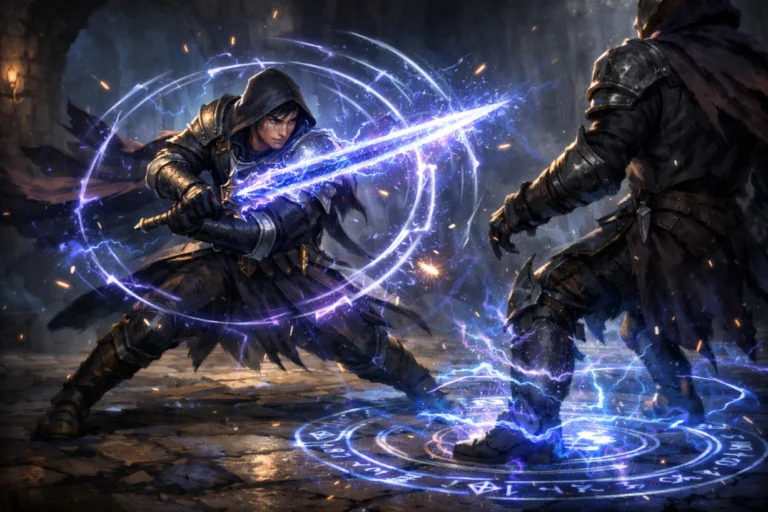
Booming Blade 5e is one of those Dungeons & Dragons spells that feels simple at first glance but keeps rewarding smart play. It mixes a melee attack with thunder damage and battlefield control, and it fits many different character builds. When we talk about Booming Blade 5e in this spell guide, we focus on clear rules, practical tactics, and how it works across editions and tables.
Booming Blade 5e spell basics
Booming Blade 5e is a cantrip from D&D 5th edition that lets you make a melee attack and wrap your target in unstable thunder energy. If the target moves after you hit it, that energy explodes and deals extra damage.
Here are the core spell details as used at most tables that follow post Tasha’s Cauldron of Everything rules.
Spell details for Booming Blade 5e
Booming Blade 5e has the following features:
- Spell level: Cantrip
- Casting time: 1 action
- Range: Self (5 foot radius)
- Components: Verbal, Somatic, Material (a melee weapon worth at least 1 silver piece)
- Duration: 1 round
- Classes: Sorcerer, Warlock, Wizard, Artificer (and others via feats or multiclass)
The material component is important. A simple unarmed strike or natural weapon does not satisfy the usual Booming Blade 5e wording. You must use a melee weapon that meets the cost requirement, such as a dagger, sword, or staff.
Official rules text condensed
When you cast Booming Blade 5e, you make a melee attack with a weapon against one creature within 5 feet of you. On a hit, the target suffers the normal weapon attack damage. Until the start of your next turn, if the target willingly moves 5 feet or more, it takes thunder damage.
The spell’s damage scales at higher character levels, which makes Booming Blade 5e stay relevant in long campaigns.
Booming Blade 5e damage scaling and level breakpoints
Like many cantrips, Booming Blade 5e grows as your character gains levels, not as you gain spell slots. That means a multiclass Eldritch Knight 7 / Wizard 3 still uses the character level 10 damage, not the caster level 10 damage.
The damage progression usually looks like this:
- Level 1 to 4: No extra damage on the hit; 1d8 thunder damage if the target moves.
- Level 5 to 10: Weapon hit gains extra 1d8 thunder damage, and the move trigger deals 2d8 thunder.
- Level 11 to 16: Weapon hit gains 2d8 thunder, move trigger deals 3d8 thunder.
- Level 17+: Weapon hit gains 3d8 thunder, move trigger deals 4d8 thunder.
Booming Blade 5e damage is all thunder, so resistance and immunity to thunder affect both the on-hit and movement damage. When building your character, remember how often your DM uses creatures with thunder resistance.
How the Booming Blade 5e action works at the table
The most confusing part of Booming Blade 5e for many groups is when the attack happens and how it interacts with the Attack action. We break it down step by step so you can run it cleanly.
Step by step casting sequence
When you use Booming Blade 5e:
- You take the Cast a Spell action, not the Attack action.
- You choose a creature within 5 feet of you.
- You make one melee weapon attack against that creature.
- If the attack hits, you deal normal weapon damage plus any Booming Blade 5e rider damage for your level.
- Until the start of your next turn, that target is sheathed in thunder energy. If it willingly moves 5 feet or more, it takes the extra thunder damage and the spell ends.
Booming Blade 5e still uses all normal attack modifiers, such as your Strength or Dexterity, proficiency, magic weapon bonuses, and class features that apply to a single melee weapon attack.
Interaction with Extra Attack
Because Booming Blade 5e uses the Cast a Spell action, it does not combine with Extra Attack in the usual way. A Fighter with Extra Attack cannot cast Booming Blade and then make another weapon attack through Extra Attack during the same action.
Some specific class features like the Bladesinger wizard’s Extra Attack (from Tasha’s) let you replace one attack with a cantrip. Those rare features are the main way to mix Extra Attack with Booming Blade 5e in one turn.
Booming Blade 5e movement trigger and rules questions
The spell’s power comes from the threat of extra damage when the target moves, which leads to a lot of table questions. We look at the most common rules issues DMs and players face.
What counts as “willing movement”
Booming Blade 5e only triggers when the target moves willingly. This usually means the creature spends its own movement, uses a bonus action, or uses an ability it controls.
Willing movement generally includes:
- Walking, climbing, flying, or swimming on your own turn
- Standing up from prone if it requires movement
- Using a feature like Step of the Wind, Misty Step, or a class ability that the creature chooses to use
Unwilling movement usually does not trigger Booming Blade 5e. Examples are being shoved, pushed by Thunderwave, dragged by a grapple, or moved by a telekinetic effect that the target does not control.
Teleportation and forced movement
Teleportation is a gray area for many groups. Rules text often treats teleportation as movement without crossing the space in between. Most tables rule that Booming Blade 5e does not trigger if the creature only teleports, since it does not actually move through spaces.
Forced movement, like push and pull effects, also tends not to trigger the spell, because the movement is not willing. When in doubt, we suggest that the DM ask, “Did the target choose to move 5 feet or more?” If the answer is no, Booming Blade 5e probably does not explode.
Timing of the damage trigger
The damage from the movement trigger happens the moment the creature has moved at least 5 feet willingly. It does not matter where it ends that movement. If a monster takes one step to exit your reach, Booming Blade 5e detonates once the full 5 feet of movement is spent.
The spell’s thunder effect ends right after the extra damage triggers. If the creature then keeps moving, it does not take more damage from the same casting.
Best classes and builds for Booming Blade 5e
Because it is a melee spell attack combo, Booming Blade 5e is most useful for characters who fight up close but care about scaling damage and control. Many popular D&D builds lean on this cantrip as a core feature.
Gish casters and melee spellcasters
So called gish characters mix spells and swords. For them, Booming Blade 5e fits right into their play style.
Common builds include:
- Hexblade Warlock: Uses Charisma with a weapon, often combines Hex, Curse, and Booming Blade 5e for strong single target pressure.
- Bladesinger Wizard: Gains Extra Attack with special wording to cast a cantrip in place of one attack, making Booming Blade a high damage option.
- Eldritch Knight Fighter: Lacks that special Extra Attack wording, but still gains from Booming Blade 5e at low levels or when using feats like War Caster for opportunity attacks.
- Arcane Trickster Rogue: Pairs Sneak Attack with the spell’s on hit thunder damage for very high nova hits on single enemies.
Many of these characters want a way to keep enemies locked next to them. Booming Blade 5e creates a choice for enemies: stay and trade hits, or move and take thunder damage.
Feats that support Booming Blade 5e
The most key feat for this cantrip is War Caster. War Caster lets you cast a spell like Booming Blade 5e as an opportunity attack when a creature provokes one by leaving your reach. That means you can:
1. Hit the enemy as a reaction with Booming Blade.
2. Deal your weapon and on hit thunder damage.
3. If they keep moving, trigger the movement thunder damage as well.
This interaction makes War Caster one of the strongest ways to raise Booming Blade 5e damage over the course of many fights.
Tactical uses of Booming Blade 5e in combat
Smart play with this spell goes beyond just hitting the closest goblin. We look at simple patterns that use the threat of thunder damage to shape the battlefield and protect allies.
Locking down enemies
When you hit a target with Booming Blade 5e, you essentially draw a line in the sand. They know moving hurts. You and your party can use that pressure in several ways.
Effective patterns include:
- Stand between the target and your weaker allies so the enemy must choose between damage or staying put.
- Use Booming Blade 5e on enemies that rely on hit and run tactics. It punishes them for leaving your reach.
- Combine it with allies that push or pull. Even if forced movement does not trigger the spell, you can herd the target into bad spots so staying still becomes costly.
We find that the spell really shines when the party talks about positioning ahead of time. A simple “If I tag it with Booming Blade, do not shove it, just stand clear” can avoid confusion mid fight.
Hit and step back tactics
If you have a good Armor Class or ways to avoid attacks of opportunity, Booming Blade 5e lets you play a dangerous dance with melee foes. Hit them, then step away so that if they chase you, they risk the extra thunder damage.
Rogues and mobile spellblades often:
1. Move in to melee.
2. Cast Booming Blade 5e and land a Sneak Attack.
3. Use Cunning Action to Disengage and move away.
4. Force the enemy to choose between standing still or taking damage to go after them.
This pattern rewards careful tracking of turn order, reaction use, and terrain. In cramped dungeons, that one square of distance can mean a lot.
Rules changes and table variations for Booming Blade 5e
Booming Blade 5e has gone through changes from its original printing in Sword Coast Adventurer’s Guide to later reprints and errata. DMs should decide which version they use and stay consistent.
Older vs newer versions
The oldest printings allowed the spell to be used with a longer range in some ways, and some interactions with things like Shadow Blade were not fully clear. Newer printings made the range “Self (5 foot radius)” and cleared up the idea that you must target a creature within 5 feet, not at longer reach.
Common table rulings include:
- Using the most recent text from Tasha’s Cauldron of Everything when there is a conflict.
- Letting natural weapons count as weapons for Booming Blade 5e in monster or homebrew builds.
- Clarifying in Session Zero how War Caster and opportunity attacks with this cantrip work.
If you build a whole character around Booming Blade 5e, it is wise to talk with your DM early about which text they follow. That avoids surprises later in a campaign.
Common mistakes and misunderstandings
Even experienced players mix up the rules for this spell under pressure. We see a few mistakes often.
Mixing Attack action and Cast a Spell
Many martial players are used to Extra Attack, so they think Booming Blade 5e is “one of their attacks” instead of a separate spell action. At most tables, you must choose between taking the Attack action with several strikes or casting this cantrip with one boosted strike.
Only class features that clearly say you can replace one attack with a cantrip let you blend them. Read your class text closely if you hope to mix them.
Triggering damage more than once
Booming Blade 5e only applies its movement damage once per casting. If the creature moves, takes the thunder damage, and then later in the same round moves again, there is no second thunder blast. The spell’s effect ends after that first triggered damage.
Some players also think the spell deals automatic damage at the start of the target’s turn, which is false. The thunder trigger is tied only to willing movement of 5 feet or more.
Applying the spell to multiple targets
The cantrip targets only one creature. Features like the War Caster feat do not change that. If you want to damage multiple enemies, other spells like Green Flame Blade or classic area spells may serve you better than Booming Blade 5e.
When to pick Booming Blade 5e for your character
Not every build needs this cantrip. We suggest asking a few questions while planning your character.
Pick Booming Blade 5e if you:
- Expect to spend a lot of time in melee range.
- Have strong single attack damage, like Sneak Attack, Hexblade’s Curse, or Divine Smite style boosts.
- Want to control enemy movement and protect ranged allies.
- Plan to take War Caster for stronger opportunity attacks.
On the other hand, a pure back line wizard who rarely enters melee might gain more from ranged cantrips like Fire Bolt or Ray of Frost. Spells that work from 60 or 120 feet away can keep you alive longer than Booming Blade 5e if you usually stand in the second or third row.
Final thoughts on Booming Blade 5e
Booming Blade 5e stays popular because it feels good to use and gives players meaningful choices. The spell rewards planning, teamwork, and understanding of movement rules. When used by a warlock, wizard, rogue, or any hybrid melee caster, it turns every hit into a threat that shapes how enemies move and react.
If you enjoy characters who stand on the front line with a weapon in one hand and magic in the other, Booming Blade 5e deserves a place in your spell list. Learn its timing, talk with your DM about which version your table uses, and build tactics with your group that make the most of that thunder ring around your foes.
FAQ about Booming Blade 5e
Can Booming Blade 5e be used with opportunity attacks?
Yes, but only if you have the War Caster feat or a similar feature that lets you replace an opportunity attack with casting a spell. With War Caster, when a creature provokes an opportunity attack by leaving your reach, you can cast Booming Blade 5e as a reaction. If your attack hits and the target keeps moving, it also triggers the movement thunder damage.
Does Booming Blade 5e work with Extra Attack?
For most classes, no. Booming Blade 5e uses the Cast a Spell action, while Extra Attack only works when you take the Attack action. Features like the Bladesinger’s special Extra Attack allow you to replace one of your attacks with a cantrip, which is the main exception. Always check the exact wording of your class features.
Can a rogue apply Sneak Attack to Booming Blade 5e?
Yes. The cantrip includes a normal melee weapon attack. If you meet all the Sneak Attack requirements, such as using a finesse or ranged weapon and having advantage or an ally within 5 feet of the target, you can add Sneak Attack damage to the hit. Then Booming Blade 5e adds its own thunder damage on top.
Does teleporting trigger the damage from Booming Blade 5e?
Most tables rule that teleporting does not count as willing movement for the spell, since the creature does not actually move through spaces. Teleportation effects like Misty Step or Dimension Door usually avoid the extra thunder damage from Booming Blade 5e. DMs who want a stricter or looser reading should state their ruling early.
Can Booming Blade 5e be used with two weapon fighting?
You can cast Booming Blade 5e with your action, then use a light weapon in your off hand with a bonus action attack, if you meet the normal rules for two weapon fighting. The cantrip’s spell attack does not itself give extra swings, though, and the bonus action attack does not gain the spell’s thunder rider. Only the main weapon used for the spell attack gains Booming Blade 5e damage.
Does Booming Blade 5e work with reach weapons?
Under the current wording, the spell’s range is Self (5 foot radius), and you choose a creature within 5 feet. That means most tables only allow you to target creatures in that 5 foot zone, even if you hold a reach weapon like a glaive. Some DMs may house rule that reach can extend the spell’s effective range, so ask your DM how they handle Booming Blade 5e with polearms.
Does the target take Booming Blade 5e damage if it is pushed or pulled?
Forced movement, such as Shove, Thunderwave, or Telekinesis, usually does not trigger Booming Blade 5e. The spell only reacts to willing movement of 5 feet or more. If the target did not choose to move, the thunder energy stays stable and does not explode. The effect then ends at the start of your next turn if it never triggered.
Can Booming Blade 5e crit and double its damage dice?
Yes. If your attack roll for Booming Blade 5e is a critical hit, you double the dice for the weapon damage and the spell’s on hit thunder damage. The movement triggered damage is not part of the critical hit, so it stays at its normal dice. This makes critical Booming Blade 5e strikes especially strong for characters who build around big single hits.