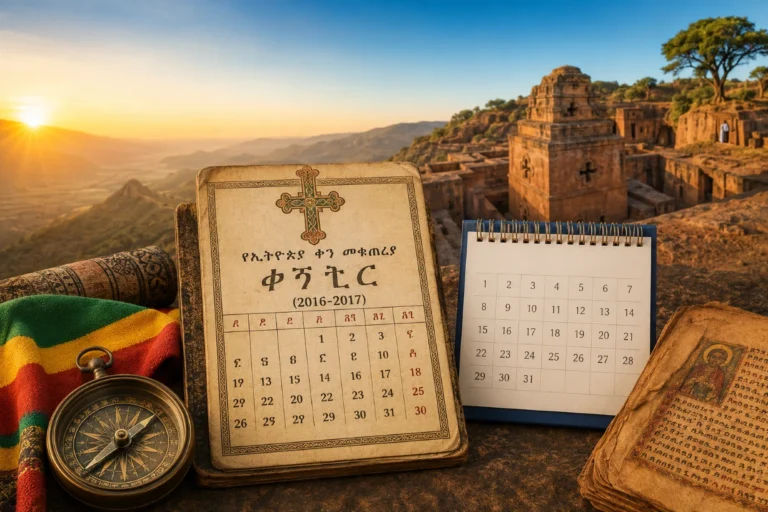
Many travelers and curious readers ask a simple question: what year is it in Ethiopia right now? The answer can feel surprising. While much of the world uses the Gregorian calendar, Ethiopia follows its own ancient system, which is about seven to eight years behind. This difference confuses people who see two different years for the same date, especially when booking flights, planning holidays, or reading Ethiopian news.
Why Ethiopia Uses a Different Calendar
To understand what year is it in Ethiopia, we need to look at history and faith. Ethiopia is one of the oldest Christian countries in the world. For centuries, it has followed the Ethiopian Orthodox Tewahedo Church, which keeps its own way of measuring years and months.
The Ethiopian calendar grew from the Coptic calendar, which itself came from the ancient Egyptian system. While Europe slowly moved to the Gregorian calendar after 1582, Ethiopia kept its traditional counting of time. This choice helped protect its culture and identity, especially during times of foreign pressure.
So when you ask what year is it in Ethiopia compared to the United States or Europe, you are really asking how two different histories measure the same moment.
How Many Years Behind Is the Ethiopian Calendar?
The Ethiopian calendar is usually about seven years and eight months behind the Gregorian calendar. The exact difference changes depending on the date, because the Ethiopian new year does not start on January 1.
In most years:
- From January 1 to September 10 or 11, the Ethiopian year is eight years behind the Gregorian year.
- From September 11 or 12 to December 31, it is seven years behind.
For example, if it is 2024 in the Gregorian calendar, people asking what year is it in Ethiopia will see:
- From January to early September: it is 2016 in Ethiopia.
- From mid September onward: the calendar changes to 2017 in Ethiopia.
This gap exists because the Ethiopian Church uses a different date for the Annunciation, the moment Christians believe the angel told Mary she would have Jesus. That change shifts the year count and keeps Ethiopia several years “behind” the Western world.
How Many Months Are in the Ethiopian Calendar?
Another point that surprises people who ask what year is it in Ethiopia is the number of months. The Ethiopian calendar has 13 months, not 12.
These months are:
- 12 main months of 30 days each
- 1 extra month called Pagumen with 5 or 6 days
That short month, Pagumen, appears at the end of the Ethiopian year. In leap years, Pagumen has 6 days instead of 5. Many Ethiopians like to say that their country has “13 months of sunshine,” a phrase often used in tourism to show the pleasant weather and unique time system.
The Names of Ethiopian Months and Their Rough Equivalents
When we look deeper into what year is it in Ethiopia, it also helps to see how months match up with the Gregorian calendar. The months in the Ethiopian calendar are:
| Ethiopian Month | Approximate Gregorian Dates |
|---|---|
| Meskerem | September 11 to October 10 |
| Tikimt | October 11 to November 9 |
| Hidar | November 10 to December 9 |
| Tahsas | December 10 to January 8 |
| Tir | January 9 to February 7 |
| Yekatit | February 8 to March 9 |
| Megabit | March 10 to April 8 |
| Miyazya | April 9 to May 8 |
| Ginbot | May 9 to June 7 |
| Sene | June 8 to July 7 |
| Hamle | July 8 to August 6 |
| Nehasse | August 7 to September 5 |
| Pagumen | September 6 to September 10 or 11 |
These dates can shift by a day in leap years. Still, this table gives a clear sense of how different the Ethiopian year looks when you try to match it with the Gregorian system and ask what year is it in Ethiopia during a given month.
When Is New Year in Ethiopia?
One of the most charming answers to what year is it in Ethiopia comes every September, when the country celebrates its new year, called Enkutatash. While much of the world celebrates on January 1, Ethiopians welcome the new year on September 11, or September 12 in a Gregorian leap year.
On Enkutatash, children sing traditional songs and carry small bouquets of yellow flowers. Families gather, share meals, and in many places, people light small bonfires at night. The timing matches the end of the rainy season. Fields turn green, and bright yellow flowers called adey abeba cover hillsides. For many Ethiopians, the fresh grass, clean air after rain, and clear blue skies add a strong feeling of hope and renewal to their answer when they think about what year is it in Ethiopia now.
How Ethiopian Leap Years Work
Like the Gregorian calendar, the Ethiopian calendar must keep in line with the solar year, the time it takes Earth to go around the sun. To do that, Ethiopia also has leap years.
In the Ethiopian system, every four years is a leap year, without exceptions. The 13th month, Pagumen, gets an extra day in leap years, so it has 6 days instead of 5. This simple pattern makes it easy to predict leap years once you know what year is it in Ethiopia at the moment.
By contrast, the Gregorian calendar has a more complex rule. Years divisible by 100 are not leap years unless they are also divisible by 400. That means 2000 was a leap year, but 2100 will not be. Ethiopia avoids this confusion by using a straight four-year pattern.
How To Convert Dates Between Calendars
Many people who search for what year is it in Ethiopia also want to convert exact dates. For example, if they see a news story dated Meskerem 1 and a certain year, they want to know the matching Gregorian date.
There are two ways to think about this:
- To go from Gregorian to Ethiopian: subtract 7 or 8 years and adjust for the month based on whether the date is before or after Ethiopian new year.
- To go from Ethiopian to Gregorian: add 7 or 8 years and again check whether you are before or after Meskerem 1.
Because of leap years and different new year dates, manual conversion can be tricky. Many people, including locals, use online Ethiopian calendar converters. These tools let you enter a date from one calendar and instantly see the match in the other, along with a clear answer to what year is it in Ethiopia for that day.
Daily Life: Living With Two Calendars
Inside Ethiopia, people learn to move between both calendars with ease. In rural areas and church life, the Ethiopian calendar remains the main reference. Farmers talk about planting and harvesting by Ethiopian months. Church holidays, fasting periods, and saints’ days all follow the Ethiopian system.
In the cities, where business and government work with the outside world, both calendars often appear side by side. When you ask what year is it in Ethiopia in a business setting, you may see documents marked with both Ethiopian and Gregorian dates.
This double system can feel confusing at first, but for most Ethiopians, it becomes a natural skill. Many children grow up able to think in both time systems without effort, switching between them in school, church, and everyday life.
Major Holidays and the Ethiopian Calendar
Holidays give another window into what year is it in Ethiopia and how time feels on the ground. Some of the most important celebrations include:
- Enkutatash: Ethiopian new year, on Meskerem 1, roughly September 11.
- Genna: Ethiopian Christmas, on Tahsas 29, around January 7 Gregorian, marked with church services and family meals.
- Timket: Ethiopian Epiphany, in Tir, celebrating the baptism of Jesus, often with colorful processions and water blessings.
- Fasika: Ethiopian Easter, date varies but follows the Ethiopian Church calendar, often after a long fasting period.
These holidays do not always match Western dates, even when they share names like Christmas and Easter. That is why knowing what year is it in Ethiopia and what month it is helps visitors and friends abroad follow along.
Cultural Meaning of the Ethiopian Calendar
For many Ethiopians, the calendar is more than a way to track days. It connects them to their ancestors, church, and land. When someone inside the country explains what year is it in Ethiopia, there is often a sense of pride behind the answer.
The 13-month system, the different year count, and the special holiday dates all show a long history of standing apart from outside influence. Ethiopia is one of the few African countries that was never fully colonized. Its unique calendar often enters the story as a symbol of that independence and resilience.
At the same time, the calendar reflects daily rhythms. The rainy season, the harvest, and traditional fasting seasons tie closely to the way months move. For older relatives in many families, the Ethiopian calendar carries memories of childhood, village life, and shared stories they heard from grandparents.
Why Tourists and Businesses Should Care
If you plan to visit Ethiopia, invest there, or work with Ethiopian partners, knowing what year is it in Ethiopia and how the calendar works can prevent mistakes. For example:
- Booking a hotel during Enkutatash or Timket without knowing their dates can lead to full rooms and higher prices.
- Signing contracts that mention only Ethiopian dates may confuse foreign partners unless both calendars appear.
- Planning events on Ethiopian fasting days could affect attendance and food planning.
Simple awareness of the calendar also shows respect. When we remember to ask what year is it in Ethiopia and not just assume the Gregorian date, we show that we value local customs and timekeeping. This mindset can open smoother conversations and stronger trust.
Common Myths About the Ethiopian Calendar
Because the system feels unusual to many outsiders, a few myths often appear when people ask what year is it in Ethiopia.
One myth claims that Ethiopians live “in the past” or are “behind” in development because their year count is lower. In reality, the number of the year is only a label. It has no link to technology, progress, or modern life. Addis Ababa, the capital, has busy roads, high-rise buildings, and modern services, even while the official calendar year is seven or eight numbers lower than in the West.
Another myth says the Ethiopian calendar is confusing and hard to use. For Ethiopians, it is simple and logical: 12 months with 30 days and a short 13th month. Many people find it easier to remember than the uneven month lengths in the Gregorian system. Confusion usually appears only when someone tries to move between the two calendars without practice.
Looking Ahead: Will Ethiopia Ever Change Its Calendar?
Some global organizations prefer standardized dates, and from time to time, people wonder if Ethiopia will someday give up its traditional system. So far, the answer from most of the country has been no.
Many Ethiopians see their calendar as part of who they are. It shapes how they answer basic questions like what year is it in Ethiopia, when children start school, when farmers plant seeds, and when families gather for holidays. Changing the calendar would mean changing those rhythms.
Instead, what we see today is a practical balance. Government offices, banks, airlines, and international companies in Ethiopia often show both calendars. People learn to read and write dates in both forms. This flexible approach lets Ethiopia stay true to its own way of counting years while still working closely with the rest of the world.
Conclusion: A Different Answer to a Simple Question
So, what year is it in Ethiopia? The answer depends on the day you ask, but it will almost always be seven or eight years lower than the Gregorian year you see on your phone or computer. That gap tells a story of ancient faith, local science, and a country that kept its own calendar while most of the world switched to another.
When we learn how the Ethiopian calendar counts its 13 months, sets its new year in September, and marks its holidays with care, we see that time itself can be cultural. Asking what year is it in Ethiopia opens a door into a rich tradition that still guides daily life for millions of people, and it reminds us that there are many valid ways to mark the same sunrise and sunset.
FAQs About the Ethiopian Calendar
Why is Ethiopia 7 or 8 years behind the Gregorian calendar?
Ethiopia is 7 to 8 years behind because the Ethiopian Orthodox Church uses a different calculation for the year of Jesus’ birth. That difference shifted the starting point of the calendar. As a result, when someone asks what year is it in Ethiopia, the answer will be several years lower than in Western countries.
What year is it in Ethiopia compared to 2024?
For most of 2024, the Ethiopian year will be either 2016 or 2017, depending on the month. Up to early September 2024, what year is it in Ethiopia can be answered as 2016. After the Ethiopian new year around September 11, it becomes 2017 in the Ethiopian calendar.
Does Ethiopia really have 13 months in a year?
Yes. The Ethiopian calendar has 13 months: 12 months of 30 days and a 13th month called Pagumen with 5 days in normal years and 6 days in leap years. This is one reason tourists like to ask what year is it in Ethiopia and how its months work, because the system feels very different from the 12-month Gregorian calendar.
When is Ethiopian New Year (Enkutatash)?
Ethiopian New Year, called Enkutatash, falls on Meskerem 1 in the Ethiopian calendar, usually on September 11 in the Gregorian calendar, or September 12 in a leap year. On that day, the answer to what year is it in Ethiopia changes as the new year begins.
How do I convert a Gregorian date to the Ethiopian calendar?
To convert dates, you often subtract 7 or 8 years from the Gregorian year and adjust for the different start of the year in September. Because leap years and offset days can be tricky, many people use an online Ethiopian calendar converter to check what year is it in Ethiopia for a specific Gregorian date.
Is the Ethiopian calendar used for official government work?
Yes. The Ethiopian calendar is used widely in government offices, schools, and local businesses. At the same time, many official documents also show Gregorian dates, especially for international work. People in Ethiopia grow used to seeing both systems, so they can answer what year is it in Ethiopia and what year it is in the Gregorian system without confusion.
Do other countries use a calendar similar to Ethiopia’s?
The Ethiopian calendar is closely related to the Coptic calendar used by the Coptic Orthodox Church in Egypt. Both trace their roots to ancient Egyptian timekeeping. However, in everyday life, Ethiopia is the main country where people regularly ask and answer what year is it in Ethiopia according to this 13-month calendar.